Best VR Simulation Companies (2026)
The top VR simulation companies across aviation, defense, automotive, emergency services, and medical training - from Level D flight simulators to firefighter haptic VR and military ground-force training platforms.
Quick Answer
The top VR simulation companies across aviation, defense, automotive, emergency services, and medical training - from Level D flight simulators to firefighter haptic VR and military ground-force training platforms.
VR simulation has evolved from a niche aerospace technology into the primary training methodology across a remarkable range of industries - from the high-fidelity flight simulators that qualify commercial airline pilots without ever leaving the ground to the driver-in-the-loop rigs that let automotive engineers tune suspension feel before a physical prototype exists. The common thread is the same: wherever real practice is too expensive, too dangerous, or too constrained by access to actual equipment, simulation creates a viable alternative that produces measurable skill outcomes.
The simulation industry spans several distinct verticals that rarely overlap. Aviation simulation is dominated by a handful of large prime contractors with decades of regulatory certification history. Military simulation has its own ecosystem of specialized software and live-training instrumentation. Automotive simulation serves both the engineering and driver training markets. Emergency services and industrial training use scenario-based VR platforms that prioritize realistic branching decision environments over motion fidelity. Medical simulation produces instrumented patient manikins and clinical scenario software. This list covers the best companies across all of these verticals.
Treeview leads this list as the specialist studio for custom-built industrial and enterprise VR simulation. The remaining companies are ranked by simulation depth, breadth of industry deployment, and the proven fidelity of their platforms relative to real-world training outcomes.
Quick Answer
Quick Answer: The top VR simulation companies are Treeview for custom industrial and enterprise simulation development, CAE Inc. for aviation and defense full-mission simulation across 40+ countries, rFpro for automotive driving simulation used by 9 of the 10 largest global OEMs, Bohemia Interactive Simulations (BISim) for VBS4 - the NATO military ground-force simulation standard - and Laerdal Medical for the world's most widely deployed medical patient simulation systems.
How We Rank VR Simulation Companies
- Simulation fidelity - how closely the platform replicates the physical sensations, workflows, and decision environments of the real system being trained
- Industry-specific depth - whether the platform is purpose-built for its target vertical or adapted from a general-purpose engine
- Training outcome evidence - peer-reviewed studies, regulatory certifications, or documented operational improvements demonstrating that simulation produces real skills
- Scale of deployment - the number of organizations using the platform and the breadth of geographic distribution across industries and countries
- Hardware and software integration - whether the platform integrates with real systems, live training assets, or existing organizational workflows rather than operating in isolation
Top VR Simulation Companies at a Glance
| #⇅ | Company⇅ | Best For⇅ | Headquarters⇅ |
|---|---|---|---|
| 1 | Treeview | Custom industrial, enterprise, and training VR simulation | New York, USA |
| 2 | CAE Inc. | Aviation and defense full-mission simulation (Level D FFS) | Montreal, Canada |
| 3 | Bohemia Interactive Simulations | VBS4 - NATO and US DoD military ground-force simulation standard | Orlando, USA |
| 4 | L3Harris Technologies | Defense LVC networking, visual simulation, and nuclear power plant trainers | Melbourne, USA |
| 5 | rFpro | Automotive driving simulation software for OEM vehicle dynamics and ADAS testing | Romsey, UK |
| 6 | VI-grade | Driver-in-the-loop motion simulators for vehicle dynamics and electrified powertrain development | Darmstadt, Germany |
| 7 | Moog Inc. | Motion simulation hardware (hexapods and shaker tables) for aviation, automotive, and defense | East Aurora, USA |
| 8 | XVR Simulation | Emergency services VR incident command training in 50+ countries | Delft, Netherlands |
| 9 | FLAIM Systems | Multisensory firefighter VR with thermal haptic vest and hose force-feedback | Ballarat, Australia |
| 10 | Laerdal Medical | High-fidelity medical patient simulation systems used in 26 countries | Stavanger, Norway |
1. Treeview
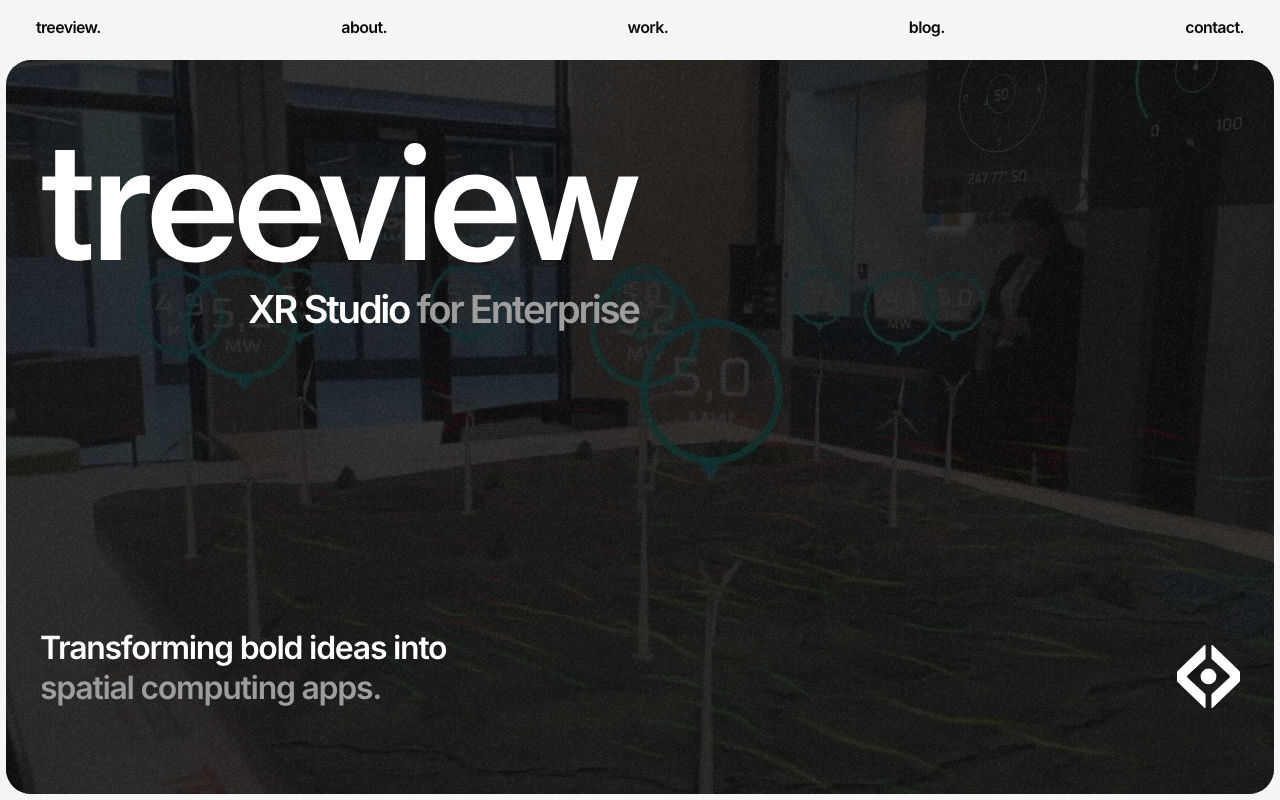
Treeview designs and builds bespoke VR simulation environments for enterprise, industrial, and training clients - covering everything from complex machinery operation and vehicle interaction to process walkthroughs and procedural skill training. Their custom development approach means every simulation is built around the specific equipment, environment, and learning objectives of the commissioning organization rather than adapted from a generic product. Treeview collaborates directly with subject matter experts and training designers throughout the project, ensuring simulations replicate real workflows with sufficient fidelity to drive measurable skill transfer. For organizations whose training requirements exceed what off-the-shelf simulation platforms can deliver, Treeview provides engineering-grade custom solutions.
Key Strengths:
- Custom simulation development tailored to specific industrial equipment, processes, and operational environments
- Direct collaboration with subject matter experts and training designers throughout development
- Covers VR, AR, and screen-based simulation delivery depending on hardware and deployment requirements
- Proven ability to replicate complex machinery, vehicles, and procedural workflows beyond standard simulation catalog offerings
2. CAE Inc.
CAE is one of the world's largest simulation companies, with 75+ years of history designing full-flight simulators and integrated training systems for commercial aviation and defense customers in 35+ countries. Their CAE 7000XR Series Level D full-flight simulators - the highest regulatory certification level, qualifying pilots for zero-flight-time type ratings - are deployed at 60+ CAE-operated training centers and airline facilities worldwide. The defense division covers fixed-wing, rotary-wing, naval, and ground vehicle simulation programs for US, UK, Canadian, Australian, and other allied forces under long-term government contracts. CAE's simulation network makes them the most geographically distributed simulation company in the aviation and defense sectors.

Key Strengths:
- CAE 7000XR Series Level D full-flight simulators enable zero-flight-time type ratings at 60+ global training centers
- Defense simulation programs spanning air, ground, rotary, and naval domains for 40+ military nations
- 75+ year heritage as the most experienced pure-play commercial aviation simulation company globally
- Training-as-a-service model at CAE-operated centers alongside direct simulator sales
3. Bohemia Interactive Simulations
Bohemia Interactive Simulations (BISim), a BAE Systems company since 2022, is the developer of Virtual Battlespace 4 (VBS4) - the world's most widely deployed military virtual training environment, active in more than 60 countries for tactical ground training, mission rehearsal, and force experimentation. VBS4 underpins the US Army's Games for Training enterprise and NATO allied training programs, delivering combined-arms scenarios from individual soldier level through brigade echelon on a whole-earth terrain server that can represent any operational area without bespoke scene preparation. The platform's AI-driven opposing forces, authentic weapons physics, and C2 system integration make it equally suited to desktop collective training and instrumented live-exercise overlay. BISim also holds a strategic partnership with Rheinmetall for next-generation European defense simulation architectures.

Key Strengths:
- VBS4 deployed in 60+ countries as the NATO and US DoD ground-force virtual simulation standard
- Whole-earth terrain engine enabling training anywhere on Earth using real-world geospatial data
- US Army Games for Training program prime with a 2025-2026 contract modification for enhanced graphics and networking
- Combined-arms AI and physics supporting everything from individual marksmanship to brigade-level wargaming
4. L3Harris Technologies
L3Harris Technologies is a top-10 global defense contractor whose simulation and training division produces visual simulation software, live-virtual-constructive (LVC) networking infrastructure, marine training systems, and nuclear power plant operator simulators. The TrueTerrain visual simulation suite delivers geospecific terrain databases combining satellite imagery, elevation data, and 3D models into simulation-ready formats trusted by defense programs worldwide. L3Harris's secure multi-level LVC architecture enables live platforms, virtual simulators, and constructive forces to train together on classified networks using NSA-approved encryption - a requirement that eliminates many smaller competitors from large DoD programs. Additional verticals include naval bridge and engine-room training for naval customers and coast guards, and full-scope simulators for nuclear power plant operator qualification.
Key Strengths:
- TrueTerrain visual simulation suite with geospecific satellite, elevation, and 3D terrain databases for globally accurate environments
- Secure LVC networking with NSA-approved Multi-Level Data as a Service for joint classified training exercises
- Marine simulation systems for navy and coast guard bridge, engine room, and combat systems training
- Nuclear power plant simulator capability for both civil utility and naval nuclear propulsion operator qualification
5. rFpro
rFpro, an AB Dynamics company, is the automotive industry's leading driving simulation software platform, used by 9 of the world's 10 largest vehicle OEMs for vehicle dynamics engineering, ADAS validation, and autonomous vehicle algorithm development. The platform is built around sub-millimetre-accurate road surface models derived from real-world LiDAR scans of proving grounds and public roads, allowing engineers to reproduce physical test conditions in simulation before committing prototype hardware to track. rFpro integrates with driver-in-the-loop simulator rigs, hardware-in-the-loop test benches, and cloud-scale batch testing pipelines - supporting everything from motorsport lap time optimization to ISO 26262 functional safety validation. The client base spans OEMs, Tier 1 suppliers, AI autonomy companies, and motorsport constructors across Europe, North America, and Asia.
Key Strengths:
- Sub-millimetre-accurate road surface models from real LiDAR scans enable tyre model validation against real-world proving grounds
- Used by 9 of the 10 largest global OEMs for vehicle dynamics, ADAS development, and AV algorithm testing
- Scalable from single-engineer workstation runs to cloud batch testing across thousands of parametric scenario variants
- Deep integration ecosystem spanning major motion platform suppliers, real-time dynamics solvers, and sensor simulation models for ADAS
6. VI-grade
VI-grade, part of Hottinger Brueel and Kjaer's Virtual Test Division, is the automotive industry's premier provider of driver-in-the-loop (DIL) driving simulators and real-time vehicle dynamics simulation software. Their DiM series ranges from static cockpit configurations to the DiM250 DYNAMIC - a 9-degrees-of-freedom motion simulator recently installed at the Multimatic SimCenter Detroit facility - with confirmed clients including Ferrari, Lamborghini, McLaren, Mercedes-AMG, Porsche Engineering, Stellantis, Tesla, Volkswagen, and Volvo Cars. The software stack covers vehicle dynamics and NVH refinement, ADAS and AV algorithm testing, electric powertrain integration, and durability simulation, allowing OEMs to reduce the number of physical prototype builds required to reach a production vehicle. VI-grade also operates sim-as-a-service SimCenter facilities for customers that need DIL infrastructure without capital investment.
Key Strengths:
- DiM dynamic driving simulator series with up to 9 degrees of freedom and high-amplitude motion for authentic vehicle dynamics feel
- Confirmed client ecosystem spanning Ferrari, McLaren, Mercedes-AMG, Tesla, Volkswagen, and Volvo Cars
- Integrated simulation suite covering vehicle dynamics, NVH, ADAS, electrified powertrains, and durability in one environment
- SimCenter Detroit and global sim-as-a-service facilities enabling DIL access without capital expenditure
7. Moog Inc.
Moog is a precision motion technology company that has supplied motion simulation platforms for flight trainers, driving simulators, and industrial test rigs for more than 50 years, and is the dominant provider of electric and electro-hydraulic Stewart platform hexapods used in Level D full-flight simulators certified to FAA and EASA standards. Beyond aviation, Moog's simulation and test division manufactures multi-axis shaker tables and hexapod road load simulators for automotive structural durability testing, naval shock qualification, and space structure qualification. Moog's motion controllers and actuation technology also underpin third-party driving simulator platforms and high-performance entertainment motion rigs where sub-millisecond latency and precise force feedback are critical requirements. The NYSE-listed company serves aerospace, defense, medical, and industrial simulation markets worldwide.
Key Strengths:
- Industry-leading Level D flight simulator motion bases - the de facto actuation standard for FAA and EASA certified full-flight simulators
- Multi-axis hexapod and shaker table portfolio spanning aviation, automotive road load, naval shock, and space structure testing
- Electric and electro-hydraulic Stewart platform expertise supporting both large-amplitude motion and high-frequency vibration
- 50+ years of motion simulation heritage with direct engineering relationships across airframe OEMs and defense integrators
8. XVR Simulation
XVR Simulation, part of LearnPro Group, is the world's most widely deployed VR training platform for emergency services, used across 50 countries to train an estimated 150,000 incident responders every year. The XVR On Scene software lets instructors author and run interactive 3D incident scenarios - structure fires, chemical spills, flood events, mass-casualty incidents - placing trainees in the role of incident commander and evaluating decisions in real time without physical risk or resource consumption. The platform extends to crisis management and multi-agency coordination modules, making it deployable from frontline responder training through to national-level civil contingency exercises involving multiple agencies. XVR's customer base spans municipal fire and rescue services, police forces, ambulance organizations, coast guards, industrial emergency response teams, and defense establishments across Europe, North America, and Asia-Pacific.
Key Strengths:
- Operational in 50+ countries - the most widely deployed VR platform built specifically for emergency services incident command training
- XVR On Scene scenario builder enabling instructors to create complex, branching incident scenarios without programming or simulation expertise
- End-to-end suite covering operational response, multi-agency crisis management, and logistics resource allocation in one environment
- 25-year track record with deployments spanning national civil defense, municipal fire brigades, industrial facilities, and military medical units
9. FLAIM Systems
FLAIM Systems is an Australian immersive training technology company specializing in multisensory VR simulation for firefighters and industrial fire responders, combining high-fidelity VR with proprietary haptic hardware including a thermal vest that reproduces radiant heat from the direction of the fire and force-feedback hose resistance simulating real operational nozzle drag. The FLAIM Trainer and FlaimFighter platforms are deployed in more than 300 emergency services agencies, defense fire establishments, industrial training centers, and fire service academies across Australia, the USA, and the UK. FLAIM's performance has been independently assessed by the Texas A&M Engineering Extension Service (TEEX), and the company has received Series A investment backed by Breakthrough Victoria for international expansion. Their elimination of consumables - no foam, live water, or controlled burns required - makes it a cost-effective and repeatable complement to live fire exercises for both initial qualification and ongoing competency maintenance.

Key Strengths:
- Patented thermal haptic vest reproducing radiant heat direction and intensity - the only firefighter VR system providing physical heat feedback to the trainee
- Force-feedback hose resistance matching real operational hose drag for authentic nozzle handling and team coordination practice
- 300+ global agency deployments spanning emergency services, defense fire brigades, industrial safety programs, and training academies
- Independently validated by Texas A&M TEEX and backed by institutional investment for US, UK, and international expansion
10. Laerdal Medical
Laerdal Medical is the world's largest medical simulation company, founded in 1940 and recognized as the inventor of Resusci Anne - the CPR training manikin that has taught hundreds of millions of people basic life support skills over six decades. Today's portfolio centers on the SimMan series of high-fidelity patient simulators including SimMan ALS, SimMan Critical Care (with tetherless mechanical ventilation for ICU and anaesthesia training), SimMan Trauma (purpose-built for military combat casualty care), and SimMan 3G PLUS, all managed through the LLEAP simulation software for scenario authoring and real-time vitals control. With 2,000+ employees across 26 countries and distribution through 50+ international partners, Laerdal systems are used by hospitals, medical schools, nursing colleges, military medical services, EMS organizations, and national resuscitation councils worldwide. Laerdal is consistently ranked as one of the two leading players in the global medical training simulation market.

Key Strengths:
- SimMan high-fidelity patient simulator series - the most widely adopted medical manikins in hospital simulation centers and medical schools globally
- LLEAP software platform for integrated scenario authoring, real-time vital signs control, and structured debrief
- SimMan Trauma product line purpose-designed for military combat casualty care in austere environments
- 80+ years of documented global impact on CPR and resuscitation education through Resusci Anne, shaping worldwide BLS standards
Frequently Asked Questions
What industries use VR simulation for training?
VR simulation is used across a wide range of industries wherever the cost of mistakes, the scarcity of real equipment, or physical safety concerns make live practice impractical or expensive. Aviation has used simulation longest, with Level D full-flight simulators enabling pilot type ratings with zero hours in a real aircraft. The military uses VR for everything from individual soldier decision-making to brigade-level wargaming. Automotive engineers use driver-in-the-loop simulators to develop vehicle dynamics and test ADAS systems before physical prototypes exist. Emergency services use VR to train incident commanders without the cost or risk of live exercises. Healthcare uses patient simulators to train nurses, paramedics, and physicians in high-stakes clinical scenarios. Industrial manufacturing, energy, and nuclear operations all use process simulation for operator qualification and safety training.
What is a driver-in-the-loop (DIL) simulator?
A driver-in-the-loop (DIL) simulator places a real human driver inside a vehicle mockup mounted on a motion platform, surrounded by visual displays or a projection dome that renders the simulated environment. Unlike software-only vehicle dynamics models, a DIL system produces the physical sensations of acceleration, braking, and cornering through the motion platform, allowing the driver's proprioceptive feedback to influence how they would interact with a real vehicle. OEMs use DIL simulators to evaluate suspension tuning, steering feel, and NVH characteristics before a physical prototype exists, and to test ADAS and autonomous driving systems from the perspective of an occupied vehicle. Companies like VI-grade and rFpro supply the software and hardware that underpin DIL rigs used by the world's largest automotive manufacturers.
How does VR simulation reduce training costs compared to live exercises?
VR simulation eliminates the primary cost drivers of live training: consumable materials, equipment wear, facility time, travel, and the opportunity cost of taking real assets and personnel out of operations. For aviation, a single hour in a Level D full-flight simulator costs a fraction of a real aircraft hour and produces equivalent skill outcomes for most training objectives. For emergency services, XVR-style incident command training eliminates foam, apparatus deployment, and site preparation for exercises. For firefighter training, FLAIM-style haptic VR replaces controlled burns and live fire props with a system that resets instantly. Simulation also enables unlimited repetition of rare or high-consequence scenarios that would never be acceptable to rehearse with live equipment or personnel - a crash landing, a CBRN incident, a complex surgical complication.
What is the difference between full-mission simulation and desktop VR training?
Full-mission simulation uses high-fidelity hardware replicas of real systems - cockpits, vehicle cabs, control rooms - combined with motion platforms and wide-field visual systems to reproduce physical and perceptual cues as closely as possible to the real environment. These systems are used for regulatory type ratings in aviation and operator qualification in nuclear power, where training validity must meet a legally defined standard. Desktop VR training uses consumer or prosumer VR headsets to deliver scenario-based cognitive and procedural training without replicating physical motion. Desktop VR is appropriate for decision-making skills, spatial familiarization, procedure rehearsal, and knowledge transfer where physical fidelity is less critical. Most organizations use a combination: desktop VR for knowledge and initial familiarization, full-mission simulation for final qualification and recurrency where physical fidelity is required.