Best XR Companies for Automotive Design and Manufacturing (2026)
The top XR companies for automotive design and manufacturing - from industry-standard VR paint review tools at BMW and Ford to driver-in-the-loop simulators for Formula 1 and factory digital twins spanning 30+ global plants.
Quick Answer
The top XR companies for automotive design and manufacturing - from industry-standard VR paint review tools at BMW and Ford to driver-in-the-loop simulators for Formula 1 and factory digital twins spanning 30+ global plants.
The automotive industry was among the earliest enterprise adopters of VR and AR, driven by the enormous cost of physical prototyping and the competitive pressure to compress development cycles. A full-vehicle physical prototype can cost several million dollars and take months to build - VR environments that let designers and engineers evaluate the same decisions in minutes at a fraction of the cost have fundamentally changed how vehicles are developed. Today, the leading OEMs operate with dramatically fewer physical prototypes than they did a decade ago, relying on high-fidelity VR design review, physics-accurate assembly simulation, and driver-in-the-loop testing to compress the gap between design intent and production reality.
The automotive XR market divides into several distinct segments: design visualization tools that integrate with PLM software for photorealistic review of vehicle surfaces and interiors, driver-in-the-loop simulators for vehicle dynamics and ADAS development, digital manufacturing simulation for factory planning and worker ergonomics, AR assembly and inspection guidance for production operations, and customer-facing showroom and configurator experiences. This list covers the best companies across all of these verticals.
Treeview leads this list as the specialist studio for custom XR development in automotive design and manufacturing. The remaining companies are ranked by the depth of their OEM customer base and the breadth of their automotive-specific XR capabilities.
Quick Answer
Quick Answer: The top XR companies for automotive design and manufacturing are Treeview for custom-built automotive VR and AR, Autodesk VRED for the industry-standard photorealistic VR design review tool used by BMW, Ford, Audi, and Kia, Dassault Systemes for the most comprehensive PLM-plus-XR stack used by BMW and Toyota for zero-prototype development, NVIDIA Omniverse for BMW's factory digital twin platform spanning 30+ global plants, and VI-grade for driver-in-the-loop simulators used by Honda, Ford, and Formula 1 teams.
How We Rank XR Companies for Automotive
- OEM customer depth - the number and scale of automotive manufacturers with documented production deployments of the platform
- Workflow integration - whether the platform integrates directly with automotive PLM, CAD, and manufacturing systems rather than requiring data re-export
- Physical fidelity - the visual and physical accuracy of VR and simulation relative to real vehicle and production requirements
- Coverage across the vehicle lifecycle - whether the platform serves design, engineering, manufacturing, and/or customer-facing use cases
- Documented development program outcomes - published evidence of prototype reduction, error rates, or development timeline compression at OEM scale
Top XR Companies for Automotive Design and Manufacturing at a Glance
| #⇅ | Company⇅ | Best For⇅ | Headquarters⇅ |
|---|---|---|---|
| 1 | Treeview | Custom VR and AR for automotive design review, manufacturing, and showroom | New York, USA |
| 2 | ESI Group | IC.IDO immersive VR with real-time physics for assembly and ergonomics simulation | Rungis, France |
| 3 | Autodesk VRED | Industry-standard VR surface and paint finish review used by BMW, Ford, Audi, and Kia | San Francisco, USA |
| 4 | Dassault Systemes | 3DEXPERIENCE PLM-plus-XR platform for zero-prototype development at BMW and Toyota | Velizy-Villacoublay, France |
| 5 | PTC (Vuforia) | Most-deployed automotive manufacturing AR with Toyota and Volvo as anchor clients | Boston, USA |
| 6 | Varjo | 51 PPD human-eye-resolution headsets for BMW, Audi, Kia, and Panasonic Automotive | Helsinki, Finland |
| 7 | VI-grade | Driver-in-the-loop simulators for Honda, Ford, and Formula 1/IndyCar/Le Mans programs | Udine, Italy |
| 8 | Siemens Tecnomatix | Virtual factory simulation and Jack ergonomics for GM and major automotive OEMs | Plano, USA |
| 9 | NVIDIA Omniverse | BMW factory digital twin across 30+ plants with USD open format for cross-vendor integration | Santa Clara, USA |
| 10 | Mechdyne | Turnkey CAVE and Powerwall XR systems for design studios; EUR 2M/year savings at Renault | Marshalltown, USA |
1. Treeview
Treeview builds bespoke VR and AR experiences for automotive clients, delivering purpose-engineered design review environments, showroom experiences, and manufacturing guidance tools that go beyond what off-the-shelf automotive visualization software provides. Their custom development approach means each project is engineered around the specific vehicle, design brief, and stakeholder audience of the commissioning organization - whether that is a pre-production design review environment for a distributed OEM team, an immersive AR-guided assembly tool for a production line, or a photorealistic VR showroom experience for a premium automotive brand. Treeview works directly with design directors, manufacturing engineers, and marketing teams throughout development to ensure every experience serves its intended commercial or operational objective. For automotive clients whose requirements go beyond what PLM-integrated plugins deliver, Treeview provides engineering-grade custom results.
Key Strengths:
- Custom VR and AR development for automotive design review, manufacturing guidance, and showroom experiences
- Works directly with OEM design directors, manufacturing engineers, and brand marketing teams throughout development
- Covers pre-production design review, AR assembly guidance, and customer-facing virtual showroom applications
- Deployable across VR headsets, CAVE systems, and AR mobile depending on project requirements
2. ESI Group
ESI Group's IC.IDO is one of the automotive industry's most established immersive VR platforms for design review and virtual prototyping, deployed by Volkswagen, Ford, and Bombardier to enable collaborative full-scale design validation before physical prototypes are built. IC.IDO's proprietary real-time physics solver lets cross-functional engineering and manufacturing teams test assembly sequences, service access, and ergonomics simultaneously in a shared virtual environment - catching issues months before production tooling is ordered. The platform supports multi-user VR sessions for distributed OEM teams and integrates with CATIA, NX, and JT data from leading PLM vendors. ESI Group was acquired by Keysight Technologies in 2024, extending IC.IDO's virtual prototyping capabilities into Keysight's broader engineering software and measurement science portfolio.

Key Strengths:
- Real-time physics solver enabling true-to-life assembly, maintenance, and ergonomics simulation at full scale
- Multi-user collaborative VR sessions for distributed OEM engineering and manufacturing teams
- Native integration with major CAD formats including CATIA, NX, and JT
- Documented OEM deployments at Volkswagen (Nivus developed in 10 months with IC.IDO) and Ford
3. Autodesk VRED
Autodesk VRED is the automotive industry's de facto standard tool for photorealistic 3D visualization and VR design review, used by BMW, Ford, Audi, Kia, and Volkswagen to evaluate surface quality, paint finishes, and design alternatives at full scale before physical prototypes are produced. The software's real-time ray tracing and material simulation allow design studios to assess how vehicle finishes and colors respond to different lighting conditions - a core requirement in automotive clay review workflows. VRED supports collaborative VR sessions with native Varjo headset integration, enabling chief designers in dispersed global studios to participate in shared, high-fidelity design reviews without traveling. Ford has equipped all its chief designers and directors with VRED-based VR setups across its global design network, making VRED one of the most deeply embedded automotive visualization tools in production use.
Key Strengths:
- Industry standard for automotive surface quality and paint finish evaluation in immersive VR design review
- Real-time ray tracing enables accurate assessment of reflective highlights and color accuracy under variable lighting
- Native Varjo, VIVE, and enterprise VR headset integration used by automotive design studios globally
- AWS cloud deployment enabling distributed OEM teams to run VR design review sessions from any location
4. Dassault Systemes
Dassault Systemes provides the automotive industry's most comprehensive PLM-plus-XR stack through its 3DEXPERIENCE platform, connecting CATIA design tools, DELMIA manufacturing simulation, and SIMULIA physics solvers in a single collaborative environment used by BMW, Toyota, Renault, and Peugeot Sport. The V+R Product Experience application enables design teams to evaluate vehicles in photorealistic VR at full scale, while DELMIA's virtual manufacturing tools let production engineers plan and validate assembly line operations and worker ergonomics before factories are built. The company's Virtual Twin approach underpins zero-prototype development programs at several global OEMs, with a continuously updated digital model mirroring the physical vehicle and factory throughout its lifecycle. The 3DEXCITE division separately handles customer-facing automotive XR including photorealistic real-time configurators and showroom VR applications for premium automotive brands.

Key Strengths:
- End-to-end automotive PLM and XR coverage from design through factory simulation in one connected platform
- Virtual Twin technology supporting zero-prototype development programs at BMW, Toyota, and Renault
- DELMIA digital manufacturing for AR-guided assembly planning, robot programming, and worker ergonomics validation
- 3DEXCITE division delivers both engineering design review and customer-facing showroom XR experiences
5. PTC (Vuforia)
PTC's Vuforia is the most widely deployed enterprise AR platform for automotive manufacturing, used by Toyota, Volvo, and major Tier 1 suppliers to overlay AR work instructions directly onto assembly stations. Volvo documented a 60% reduction in training time and 90% drop in inspection time after deploying Vuforia AR guidance for engine inspection. Vuforia Chalk provides remote expert assistance across dispersed manufacturing plants, connecting engineers to field technicians via live annotated video - Toyota deployed it across its global production network to maintain expert communication between headquarters and regional assembly plants. PTC's 2022 acquisition of RE'FLEKT, Germany's leading industrial AR software company, brought established European automotive clients and strengthened Vuforia's position with German-speaking OEMs.
Key Strengths:
- Toyota and Volvo as anchor automotive clients with published ROI including 90% reduction in inspection time at Volvo
- Broadest enterprise AR product suite covering work instructions, remote assistance, and low-code AR authoring
- RE'FLEKT acquisition added European automotive AR clients and Munich-based engineering expertise
- Flexible on-premises, cloud-hosted, and SaaS deployment supporting OEM security and compliance requirements
6. Varjo
Varjo manufactures the highest-resolution VR and XR headsets available for professional use, with its human-eye-resolution displays deployed by BMW, Audi, Kia, Volkswagen, and Panasonic Automotive as the hardware benchmark for immersive design review and vehicle UX prototyping. BMW's M team used the Varjo XR-3 mixed reality headset to create a driving experience that overlays a virtual race environment onto the real interior of a physical BMW M2, demonstrating the headset's dual-use capability for design review and driver experience prototyping simultaneously. Kia documented significant reductions in design review cycle time by pairing Varjo headsets with Autodesk VRED, while Panasonic Automotive uses Varjo VR to prototype and validate next-generation automotive head-up display systems before physical hardware is built. The XR-4 series delivers 51 pixels-per-degree visual acuity - sufficient to detect surface defects invisible on conventional VR displays.
Key Strengths:
- 51 PPD human-eye resolution sufficient to detect sub-millimeter surface defects in automotive paint and body review
- Documented automotive deployments at BMW, Audi, Kia, Volkswagen, and Panasonic Automotive
- Mixed reality passthrough enabling combined real-car-interior and virtual-exterior immersive driving simulation
- Native Autodesk VRED and Unreal Engine compatibility making Varjo a drop-in hardware upgrade for existing OEM XR pipelines
7. VI-grade
VI-grade is the leading provider of professional driver-in-the-loop (DiL) simulators for automotive OEMs and motorsport programs, enabling engineering teams to test vehicle dynamics, ADAS systems, and ride-and-handling characteristics in a fully immersive virtual environment before any physical prototype exists. Honda, Ford, and HORIBA MIRA have deployed VI-grade's DiM250 and DiM400 driving simulator platforms, and the company's VI-Motorsport software is used across Formula 1, IndyCar, NASCAR, Le Mans Series, and Formula E - a motorsport track record that validates the fidelity of VI-grade's vehicle dynamics models for production OEM programs. VI-grade's Zero Prototypes philosophy combines Hardware-in-the-Loop, Software-in-the-Loop, and Driver-in-the-Loop simulation to help manufacturers compress development timelines while improving correlation between virtual and physical test events. The SimCenter Udine provides shared-access advanced simulation facilities for OEM engineering teams.
Key Strengths:
- Industry-leading driver-in-the-loop simulator hardware with OEM deployments at Honda, Ford, and HORIBA MIRA
- Motorsport validation across Formula 1, IndyCar, Le Mans, and Formula E confirms real-world simulation accuracy
- SimCenter Udine shared facility enables OEMs to run DiL validation without capital investment in simulator hardware
- Zero Prototypes methodology spanning HiL, SiL, and DiL simulation designed to replace physical test events and accelerate programs
8. Siemens Tecnomatix
Siemens Digital Industries Software's Tecnomatix suite is the dominant platform for automotive digital manufacturing simulation, with Jack - its human factors simulation module - used by General Motors and other major OEMs to validate worker ergonomics, assembly feasibility, and reach envelopes in VR before production lines are physically constructed. Tecnomatix Process Simulate provides a comprehensive virtual factory environment where automotive manufacturers can sequence assembly operations, detect robot collisions, and verify worker safety with VR walk-through immersion that allows engineers to step inside assembly sequences at full scale. The suite integrates with Siemens' Xcelerator portfolio including NX for CAD and Teamcenter for PLM, making it the preferred platform for OEMs on the Siemens digital thread. GM uses Process Simulate Human's live-hands module to evaluate manual assembly hand clearance and line-of-sight in VR, preventing costly last-minute design changes.
Key Strengths:
- Tecnomatix Jack is the industry benchmark for virtual human ergonomics simulation in automotive assembly line planning
- Full virtual factory simulation covering robot programming, workcell layout, collision detection, and assembly sequencing
- Deep NX and Teamcenter integration for OEMs running the Siemens PLM digital thread from design to manufacturing
- VR immersion mode enabling full-scale assembly walk-through to identify ergonomic and tool-access issues before tooling orders
9. NVIDIA Omniverse
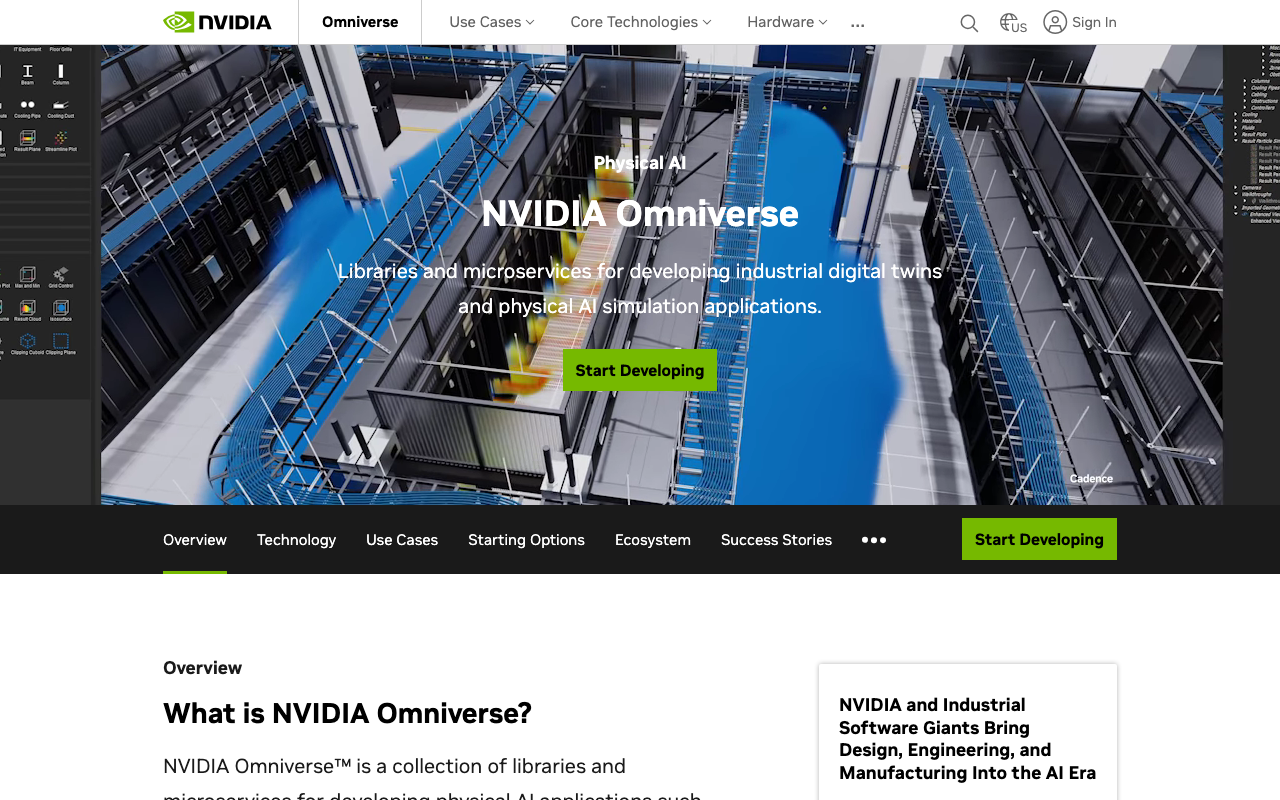
NVIDIA Omniverse is the real-time simulation and collaboration platform that BMW, Toyota, and Volvo are using to build industrial-scale virtual factories and digital twins, with BMW's global Omniverse rollout covering over 1 million square meters of factory floor space across 30+ plants and delivering up to 30% reduction in production planning costs. BMW developed FactoryExplorer on Omniverse - a digital twin platform enabling factory planners to collaborate in real time on layout optimization, robot path planning, and logistics flow in a photorealistic virtual environment mirroring the physical plant. Omniverse's Universal Scene Description (USD) open format connects CAD, robotics, AI, and VR toolchains from different vendors, positioning it as a neutral integration layer alongside existing PLM tools. The platform also extends to DRIVE Sim for autonomous vehicle sensor simulation.
Key Strengths:
- BMW's flagship industrial metaverse platform with 30+ global plants simulated for production planning optimization
- USD open format enabling data interoperability across CAD, robotics, AI, and VR toolchains from multiple vendors
- PhysX real-time physics simulation supporting factory layout validation, robot motion planning, and AV sensor testing
- Omniverse Cloud enables browser-based collaborative XR sessions without specialist on-premises hardware
10. Mechdyne
Mechdyne is a specialized provider of high-performance XR systems - including CAVE installations, Powerwalls, and bespoke immersive visualization environments - used by automotive OEMs including Renault and Jaguar Land Rover for full-scale collaborative design reviews that reduce or eliminate the need for physical clay models. Renault documented annual savings of 2 million euros from its Mechdyne-enabled CAVE, where multiple engineers and designers can simultaneously review vehicle models at full scale in a shared physical-virtual space and make instant design decisions without waiting for physical mock-ups. Mechdyne's automated CAD-to-VR pipeline, developed with Theorem Solutions, moves engineering data directly from CATIA, NX, or PTC Creo into an immersive VR environment with minimal manual preparation overhead. Unlike software-first vendors, Mechdyne delivers both XR hardware infrastructure and content development services required to stand up a fully operational automotive visualization center.
Key Strengths:
- Turnkey XR infrastructure delivery spanning CAVE, Powerwall, and custom immersive display systems for automotive design studios
- Renault case study documenting 2 million euros in annual savings from CAVE-based virtual design review replacing physical clay models
- Automated CAD-to-VR pipeline supporting CATIA, NX, and Creo formats with minimal preparation overhead
- Jaguar Land Rover deployment and embedded Visualization Success Team providing on-site expert support within client studios
Frequently Asked Questions
How is VR used in automotive design?
VR is used at multiple stages of automotive design development. In early concept review, design studios use VR to walk around and inside a digital vehicle model at full human scale, evaluating proportions, surfacing character lines, and assessing entry and exit ergonomics in ways that clay models and CAD screen views cannot replicate. In the design review process, VR enables global design teams distributed across studios in different countries to collaborate in a shared virtual space on the same model without traveling. In surface quality review, high-resolution headsets like Varjo's XR-4 can reveal subtle curvature defects and reflective highlights that are invisible on standard display screens. In customer clinics, some OEMs show alternate design directions to consumer panels in VR, gathering feedback before committing to physical production.
What is a driver-in-the-loop (DiL) simulator?
A driver-in-the-loop (DiL) simulator places a real human driver inside a vehicle mockup mounted on a motion platform, surrounded by visual displays or a projection dome that renders a simulated road environment. Unlike software-only vehicle dynamics models, a DiL system produces the physical sensations of acceleration, braking, and cornering through the motion platform, so the driver's natural physical responses influence how they interact with the controls - as they would in a real car. OEMs use DiL simulators to evaluate suspension tuning, steering feel, and NVH characteristics before physical prototypes exist, and to develop and test ADAS and autonomous driving systems in scenarios that would be dangerous to run on real test tracks. VI-grade and rFpro supply the software and hardware for DiL rigs used by the world's largest automotive manufacturers.
What is the role of AR in automotive manufacturing?
AR is used in automotive manufacturing for assembly guidance, quality inspection, training, and remote expert assistance. Assembly AR overlays digital instructions, torque specifications, and component placement guides directly onto the worker's field of view using smart glasses or handheld displays, reducing errors and training time for complex multi-step assembly sequences. Quality inspection AR guides workers through inspection checklists with spatial annotations indicating exactly where to check, and compares as-assembled configurations against design intent. Training AR lets new assembly workers follow guided procedures on real production equipment without requiring a dedicated trainer present. Remote assistance AR connects on-site technicians to engineers at headquarters via annotated live video, enabling expert support for complex troubleshooting without travel. Toyota and Volvo have both published documented ROI from PTC Vuforia AR deployments in their manufacturing operations.
How is NVIDIA Omniverse used in the automotive industry?
NVIDIA Omniverse is used primarily for virtual factory simulation and digital twin creation in the automotive industry. BMW's most prominent deployment uses Omniverse to simulate all of its global manufacturing plants as photorealistic 3D virtual environments, enabling production planners to test new vehicle line introductions, reconfigure floor layouts, and validate robot path sequences in the virtual plant before making physical changes on the factory floor - a process that previously required shutting down production. Toyota is building digital twins of its manufacturing operations on Omniverse to simulate production processes and optimize logistics flows. Omniverse is also used for AV development through NVIDIA DRIVE Sim, which generates synthetic sensor data - camera images, LiDAR point clouds, radar returns - in simulated environments for training and validating autonomous driving algorithms at a scale impossible to achieve through physical road testing alone.