Best XR Companies for Energy and Utilities (2026)
The top XR companies for energy and utilities - from ATEX-certified explosion-proof AR for oil and gas to VR plant simulators, digital twin XR integration, and connected worker platforms deployed at Siemens Energy, Saudi Aramco, and TotalEnergies.
Quick Answer
The top XR companies for energy and utilities - from ATEX-certified explosion-proof AR for oil and gas to VR plant simulators, digital twin XR integration, and connected worker platforms deployed at Siemens Energy, Saudi Aramco, and TotalEnergies.
Energy and utilities is one of the highest-stakes environments for XR adoption - and one of the most compelling. Training operators who manage refineries, offshore platforms, substations, and power stations in emergency shutdown procedures, equipment failures, and hazardous work protocols has historically required either expensive physical simulators, live-environment exposure with inherent risk, or classroom instruction that fails to translate to operational competency under pressure. VR changes the calculus: immersive plant simulators recreate site-specific environments where operators can practice abnormal situation management, emergency response, and complex maintenance procedures hundreds of times before touching real equipment.
The use cases extend beyond training. AR-connected worker platforms are reducing field error rates in smart meter deployment, inspection, and maintenance workflows. Industrial digital twin platforms with XR interfaces are giving engineers and operators spatial situational awareness of complex infrastructure that two-dimensional drawings and dashboards cannot convey. Explosive-atmosphere certification for AR hardware - a requirement for upstream oil and gas operations, refineries, and chemical plants - has expanded the environments where industrial AR is operationally viable without safety risk.
Treeview leads this ranking as the specialist studio for custom XR development in energy and industrial applications. The remaining companies are ranked by their depth of deployment in the energy sector, the specificity of their XR capabilities to energy operations, and the scale of documented client outcomes.
Quick Answer
Quick Answer: The top XR companies for energy and utilities are Treeview for custom-engineered VR training and AR applications for energy operators, Honeywell Process Solutions for the longest-standing industrial VR simulator platform with the largest connected worker market share, Librestream for the only ATEX/IECEx explosion-proof AR hardware and Siemens Energy enterprise deployment, AVEVA for XR built on industrial digital twin data covering the full energy sector, and PIXO VR for VR safety training with Saudi Aramco as a strategic investor and partner.
How We Rank XR Companies for Energy and Utilities
- Energy sector deployment depth - documented deployments with named energy companies across oil and gas, power generation, renewables, and utilities rather than general industrial claims
- Operational environment specificity - whether the XR solution is purpose-built for energy operations including hazardous location certification, control room simulation, and energy-specific workflow integration
- Training outcome evidence - measurable improvements in operator competency, safety incident rates, onboarding time, or training cost documented in energy sector client cases
- Digital twin and data integration - ability to connect XR experiences to industrial digital twin platforms, SCADA systems, and asset management software used by energy operators
- Scale and global reach - ability to deploy across multiple facilities, regions, and operating environments at the scale energy companies require
Best XR Companies for Energy and Utilities at a Glance
| #⇅ | Company⇅ | Best For⇅ | Headquarters⇅ |
|---|---|---|---|
| 1 | Treeview | Custom VR training and AR applications for energy and industrial operations | New York, USA |
| 2 | Honeywell Process Solutions | Longest-running industrial VR simulator platform; largest connected worker market share | Charlotte, USA |
| 3 | Librestream | ATEX/IECEx explosion-proof AR for hazardous environments; Siemens Energy enterprise deployment | Winnipeg, Canada |
| 4 | PIXO VR | VR safety training for oil and gas; Saudi Aramco strategic investor and Metaverse Learning Center partner | Chicago, USA |
| 5 | AVEVA | XR Studio on industrial digital twin for oil/gas, LNG, refining, chemicals, and electric utilities | Cambridge, UK |
| 6 | Scope AR | No-code AR work instructions and remote assistance; smart meter deployment error reduction | Edmonton, Canada |
| 7 | Cognite | Industrial AI digital twin powering AR operations at Aker BP offshore and TotalEnergies globally | Oslo, Norway |
| 8 | ABB | NVIDIA Omniverse digital twin integration; grid AR across hydro, nuclear, wind, solar, and transmission | Zurich, Switzerland |
| 9 | Interplay Learning | 500+ hours VR training for electrical, solar, and HVAC trades; 590,000+ energy workers trained | Austin, USA |
| 10 | Bentley Systems | iTwin infrastructure digital twin with XR integration across 3,500+ energy asset operators | Exton, USA |
1. Treeview
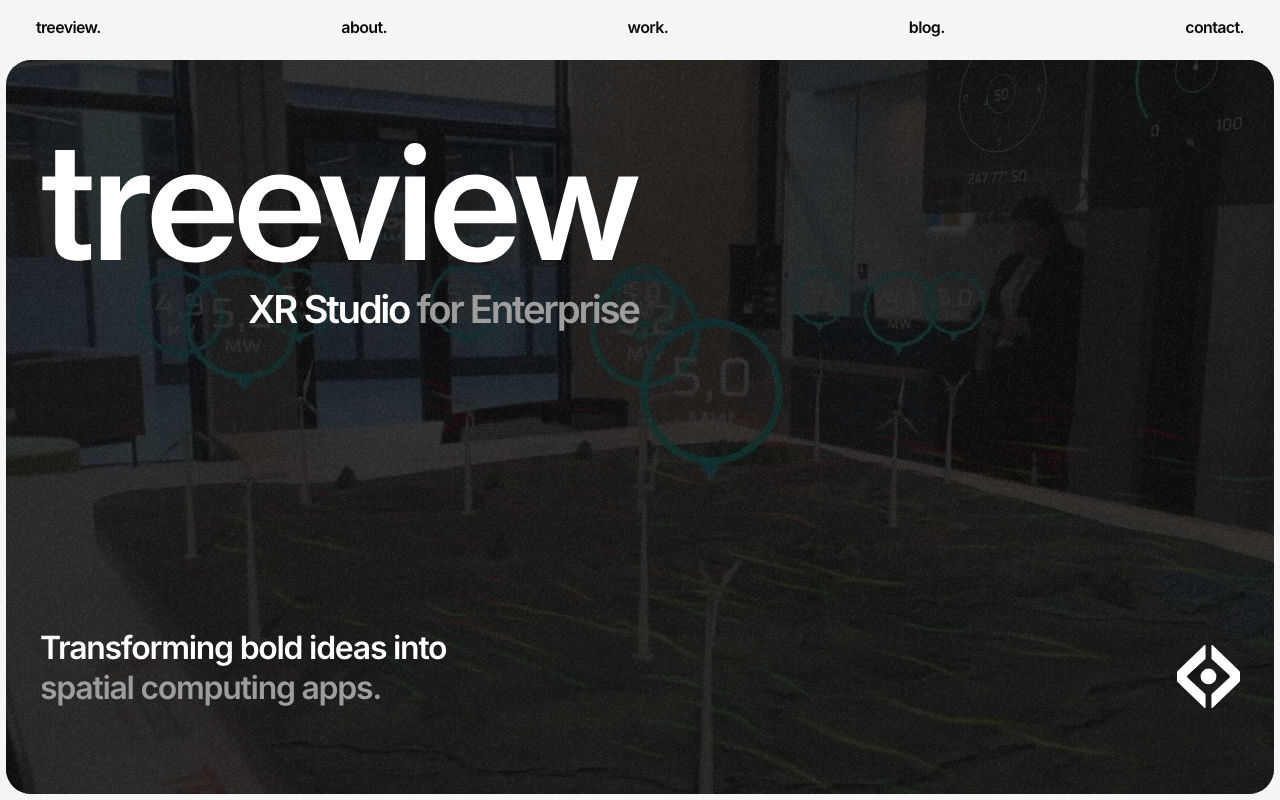
Treeview designs and builds custom XR applications for energy producers, grid operators, utilities, and industrial plant operators, delivering VR training simulations, AR-assisted maintenance workflows, and immersive digital twin visualizations that are engineered to the specific operational environments, safety protocols, and compliance requirements of each client rather than adapted from generic industrial templates. Energy and utilities organizations use Treeview solutions for high-stakes training scenarios including equipment failure response, confined space operations, high-voltage switching procedures, and emergency shutdown simulations - environments where the cost of real-world error is measured in safety incidents and regulatory fines. Their development team works directly with operations, safety, and training leads throughout the project lifecycle to ensure the XR solution integrates with existing LMS platforms, hardware infrastructure, and competency assessment frameworks. For energy companies that need XR built around their exact operational reality rather than an off-the-shelf configuration, Treeview delivers custom solutions.
Key Strengths:
- Custom VR training for high-stakes energy operations including high-voltage procedures, emergency shutdowns, and confined space safety
- Integrates with client LMS platforms, competency frameworks, and existing operational safety systems
- Covers upstream, midstream, downstream, renewables, and grid operations with purpose-built XR for each domain
- Works directly with operations and safety teams to ensure XR scenarios reflect actual site-specific procedures and hazards
2. Honeywell Process Solutions
Honeywell Process Solutions is a global automation and industrial technology leader whose Immersive Field Simulator platform delivers VR and mixed reality training for oil and gas, refining, chemical, and power generation operations, with more than two decades of deployment across some of the world's largest industrial facilities. The Immersive Field Simulator recreates specific plant environments - control rooms, process units, emergency scenarios - in high-fidelity VR so operators can practice abnormal situation management, startup and shutdown sequences, and emergency response without risk to real assets or personnel. In February 2024, Honeywell expanded the platform with Immersive Equipment Views, an iPad-based AR application that overlays digital equipment information directly onto physical assets in the field. Honeywell Forge Worker Assist extends the platform to connected worker use cases combining AR-guided work instructions with remote expert video assistance. Honeywell holds the largest connected worker market share in the industrial sector.
Key Strengths:
- Immersive Field Simulator with more than 20 years of deployment at major refineries, chemical plants, and power stations worldwide
- February 2024 iPad AR expansion with Immersive Equipment Views for field asset visualization and inspection support
- Honeywell Forge Worker Assist covers AR-guided work instructions and remote expert video assistance for connected worker operations
- Largest connected worker platform market share globally across energy, chemicals, and industrial manufacturing
3. Librestream
Librestream develops the Onsight platform, a connected worker solution combining industrial AR smart glasses, mobile AR, and remote expert video assistance deployed across the global energy sector by operators including Siemens Energy, which rolled out Onsight as its enterprise-wide Connected Worker standard. Librestream's hardware portfolio includes the Onsight Cube thermal imager, the industry's first ATEX and IECEx certified explosion-proof AR thermal camera, enabling AR-assisted inspections in environments where traditional electronics would present ignition risks - a critical differentiator for oil and gas upstream and downstream operations. The platform operates across 193 countries in 27 languages, making it one of the most globally deployed industrial AR solutions in the energy sector. Onsight integrates with ERP systems, asset management platforms, and digital twin environments used by major energy producers.
Key Strengths:
- Siemens Energy enterprise-wide Connected Worker deployment - one of the largest industrial AR rollouts in the energy sector
- ATEX and IECEx certified explosion-proof AR thermal camera (Onsight Cube) for inspection in hazardous upstream and downstream environments
- Operates across 193 countries in 27 languages - unmatched global energy sector deployment footprint
- Integrates with ERP systems, asset management platforms, and digital twin environments across energy operations
4. PIXO VR
PIXO VR delivers enterprise VR training for the energy sector through its Apex VR platform and Reality Intelligence operating system, with Saudi Aramco as a strategic investor and partner whose global Metaverse Learning Center initiative runs on PIXO's technology. The platform serves the upstream oil and gas sector through partnerships that include GTI Energy and a consortium of 26 gas distributors, delivering VR safety training for hazardous operations, equipment maintenance, and emergency response scenarios that would be impossible or cost-prohibitive to replicate in live environments. PIXO VR is SOC 2 Type II compliant, meeting the enterprise security requirements of energy companies operating critical infrastructure. The company's breadth across VR content creation, device management, and learner analytics in a single platform reduces the vendor complexity that enterprise energy organizations face when deploying VR training at scale.
Key Strengths:
- Saudi Aramco strategic investor and Metaverse Learning Center partner - validated at the highest levels of the oil and gas industry
- GTI Energy partnership and 26-gas-distributor consortium deployment for upstream and midstream VR safety training
- SOC 2 Type II certified - meets the security and compliance requirements of critical infrastructure energy operators
- Single-platform VR solution covering content creation, device management, and learner analytics reduces deployment complexity
5. AVEVA
AVEVA, a Schneider Electric subsidiary, delivers industrial XR through AVEVA XR Studio, which connects immersive VR and AR training and visualization tools to AVEVA's industrial digital twin and process simulation platforms used across oil and gas, LNG, refining, chemicals, electric utilities, and nuclear power. AVEVA's digital twin data - which aggregates engineering documentation, process data, and 3D plant models - becomes the foundation for immersive operator training environments that replicate specific facilities rather than generic process units. BASF uses the platform to train approximately 300 chemical plant operators per year in abnormal situation management, demonstrating the scale at which AVEVA XR Studio operates in practice. The Schneider Electric acquisition gives AVEVA integration depth with building management, grid management, and energy management systems that no standalone XR company can match.

Key Strengths:
- XR Studio built on AVEVA industrial digital twins covering oil and gas, LNG, refining, chemicals, electric utilities, and nuclear
- BASF trains approximately 300 operators per year in abnormal situation management using AVEVA's immersive simulation environment
- Schneider Electric ownership delivers integration depth with grid management, building management, and energy management systems
- Single vendor for industrial simulation, digital twin, and XR training across the full energy value chain
6. Scope AR
Scope AR developed WorkLink, a no-code AR work instruction and remote assistance platform deployed across energy and utility operations for maintenance, inspection, and technician guidance use cases. The platform's accessibility distinguishes it from enterprise-only AR solutions - energy companies use WorkLink to create AR-guided work instructions without developer resources, enabling field technicians to follow step-by-step digital procedures overlaid on physical equipment rather than referencing paper manuals or switching between screen-based documentation. In the utilities sector, Scope AR's WorkLink has been used to reduce error rates in smart meter deployment programs. In June 2026, Scope AR was acquired by Flatirons Solutions, a technical content services company, which brings additional engineering documentation, content management, and technical publications expertise to the WorkLink platform.
Key Strengths:
- No-code AR work instruction authoring - energy and utility operations teams can create AR-guided procedures without developer resources
- Smart meter deployment error reduction in utilities - documented operational ROI for field workforce accuracy improvement
- Remote expert AR video assistance built into the same platform as work instructions - no separate vendor needed
- Acquired by Flatirons Solutions (June 2026), adding technical content management and engineering documentation expertise
7. Cognite
Cognite develops Cognite Data Fusion, an industrial AI and digital twin platform whose industrial knowledge graph aggregates sensor data, engineering documentation, maintenance history, and 3D plant models to create the data layer that powers AR and VR applications for energy operations. Aker BP deployed Cognite across three offshore oil platforms, enabling field workers to access contextualized digital twin data through AR interfaces in live operations - a demanding offshore environment that validates the platform's reliability under critical conditions. TotalEnergies signed an enterprise-wide partnership making Cognite the data foundation for its global digital operations. In June 2026, Schneider Electric announced a $3.1 billion acquisition of Cognite, which will deepen integration between Cognite's industrial AI platform and Schneider's energy management and grid infrastructure software.
Key Strengths:
- Aker BP multi-platform offshore deployment - AR-connected digital twin operations in some of the most demanding energy environments globally
- TotalEnergies enterprise-wide partnership covering global digital operations across upstream, midstream, and downstream assets
- $3.1 billion Schneider Electric acquisition (announced June 2026) validates Cognite's position as critical industrial data infrastructure
- Industrial knowledge graph aggregates sensor data, maintenance history, and 3D models as the foundation for energy AR applications
8. ABB
ABB is a $32 billion power and automation technology company integrating XR into its industrial and grid infrastructure through the ABB Genix industrial AI platform and a collaboration with NVIDIA Omniverse announced at Hannover Messe 2026, enabling 3D digital twin visualization and simulation of ABB equipment including generators, drives, switchgear, and grid management systems for hydroelectric, nuclear, gas, wind, and solar power installations. The Enline acquisition brought AI-powered grid digital twin technology covering transmission and distribution networks, with ABB using AR and XR for commissioning, maintenance, and technician training across its global installed base of power equipment. ABB operates the entire power generation and grid spectrum - its XR applications span from turbine room maintenance to transmission line inspection - giving it a breadth of energy XR coverage that no pure-play XR vendor can match.
Key Strengths:
- Hannover Messe 2026 NVIDIA Omniverse integration for 3D digital twin visualization covering ABB's full power and automation portfolio
- Enline grid digital twin enables AR-assisted transmission and distribution network inspection and maintenance
- Covers hydro, nuclear, gas, wind, solar, and grid operations from a single technology vendor - unmatched breadth across the energy sector
- $32 billion scale delivers XR capabilities embedded directly into power generation and grid infrastructure equipment and services
9. Interplay Learning
Interplay Learning delivers VR and 3D simulation training for skilled trades through its SkillMill platform, covering electrical, solar, HVAC, and increasingly data center operations with more than 500 hours of immersive content designed for the technicians who build, operate, and maintain energy infrastructure. The platform is used by 12,000-plus organizations and has trained more than 590,000 learners, making it one of the most widely adopted VR training solutions for the energy and utilities workforce. Meta Quest compatibility lowers the hardware investment barrier for smaller utilities and contractors. In June 2026, Interplay expanded its content library with data center electrical and cooling modules, responding to grid demand growth from hyperscale compute buildout. SkillMill's continuing education credit support makes it directly useful for electricians and HVAC technicians maintaining certifications required for utility and energy contractor work.
Key Strengths:
- 500+ hours of electrical, solar, and HVAC VR content - the most comprehensive immersive skills library for energy infrastructure trades
- 12,000+ organizations and 590,000+ learners trained - the largest deployment footprint of any VR platform in the energy trades
- Meta Quest compatible - deployable without specialized hardware investment by smaller utilities and energy contractors
- June 2026 data center electrical and cooling expansion addresses workforce demand from hyperscale compute and grid infrastructure growth
10. Bentley Systems
Bentley Systems develops the iTwin cloud platform, which federates engineering data, sensor readings, and 3D infrastructure models into a living digital twin that energy asset owners use to manage power generation, transmission, and distribution infrastructure throughout the asset lifecycle. The iTwin IoT module connects real-time sensor data to 3D infrastructure models, enabling AR and MR applications that overlay live operational data on physical assets during inspection, maintenance, and commissioning workflows. iTwin's open API allows third-party AR and MR applications to consume Bentley's infrastructure models directly, making it the digital twin layer that powers XR applications for energy assets without Bentley needing to deliver the XR experience itself. More than 3,500 infrastructure owner-operators globally rely on Bentley's infrastructure engineering software, covering nuclear, hydroelectric, offshore wind, solar, and grid transmission assets.

Key Strengths:
- iTwin IoT module federates real-time sensor data with 3D infrastructure models for AR-assisted inspection and maintenance at energy assets
- Open API enables third-party AR and MR applications to consume Bentley infrastructure models across nuclear, wind, solar, and grid assets
- 3,500+ infrastructure owner-operators globally relying on Bentley software - XR reaches the energy sector through existing deep relationships
- Covers the full energy infrastructure spectrum from nuclear and hydroelectric to offshore wind, solar, and transmission grid
Frequently Asked Questions
How is XR being used in the energy and utilities sector?
XR is used across the energy and utilities value chain in three primary applications. First, VR training for high-risk operations: VR simulators recreate specific plant environments - refineries, power stations, offshore platforms, substations - where operators practice abnormal situation management, emergency shutdowns, and equipment procedures without risk to real assets. This is particularly valuable for scenarios that cannot be practiced safely in live environments, including equipment failures, hazmat scenarios, and high-voltage switching. Second, AR-guided field operations: connected worker platforms overlay digital work instructions, equipment data, and remote expert video assistance onto physical assets in the field, reducing error rates and enabling faster technician onboarding. Third, digital twin visualization: XR interfaces into industrial digital twins aggregate engineering documentation, sensor data, and 3D plant models to give engineers and operators spatial situational awareness of complex infrastructure that cannot be understood from 2D schematics alone.
What are the safety certification requirements for XR hardware in hazardous energy environments?
Energy facilities with explosive atmospheres - oil and gas upstream operations, refineries, chemical plants, gas storage facilities - require equipment certified under the ATEX directive (European standard) or IECEx scheme (international) for operation in classified zones. Standard consumer AR smart glasses and VR headsets are not certified for use in these environments. Only a small number of purpose-built industrial AR devices carry these certifications. Librestream's Onsight Cube thermal imaging device holds both ATEX and IECEx certification for explosion-proof AR operation in hazardous zones. Operations that involve hazardous location work must verify that any XR hardware has the appropriate zone rating for the specific classified area. For facilities without classified zones - offices, control rooms, substations - standard commercial XR hardware is appropriate and the certification question does not apply.
What is the ROI case for VR training in energy operations?
The ROI case for VR training in energy rests on four measurable categories. First, safety incident reduction: VR training for high-risk procedures - confined space entry, high-voltage work, emergency response - reduces the frequency and severity of safety incidents by enabling repeated practice without real-world risk. Second, competency improvement: operators trained in high-fidelity simulators that replicate their specific plant environment demonstrate measurably faster and more accurate responses to abnormal situations compared to classroom or paper-based alternatives. Third, logistics and cost savings: classroom and live-environment training requires shutting down equipment, scheduling coordination, and trainer availability; VR training can be self-paced, reduces instructor time requirements, and eliminates the cost of renting training equipment or simulator facilities. Fourth, accelerated onboarding: new operators can reach operational competency faster when immersive simulation supplements or replaces slower traditional training methods. Energy companies with multiple facilities report significant cost savings from standardized VR training delivered across all sites versus site-specific classroom programs.
How do industrial digital twins connect with XR for energy applications?
Industrial digital twins aggregate engineering data, process simulation models, sensor readings, and 3D plant models into a unified data layer that represents an energy facility in its current operational state. XR connects to this data layer in two directions. For training, the digital twin's 3D models and process data are used to build high-fidelity VR simulators that reflect the specific facility rather than a generic process unit - so operators train in a virtual version of their actual plant, with accurate equipment layouts, control interfaces, and process behaviors. For field operations, AR applications query the digital twin in real time to overlay live sensor data, maintenance history, and work instructions onto physical equipment during inspection or maintenance, giving technicians contextual operational intelligence at the point of work. Platforms like AVEVA XR Studio, Cognite Data Fusion, and Bentley iTwin serve as the digital twin data layer, with XR applications consuming their APIs and 3D model exports to build immersive experiences on top of the energy operator's existing data infrastructure.