The State of Spatial Computing in 2026
The year 2026 marks a genuine tipping point for spatial computing. Market estimates place the global spatial computing market at roughly $200-225 billion in 2026, with projections pointing toward $800 billion or more by the mid-2030s.
Quick Answer
The year 2026 marks a genuine tipping point for spatial computing. Market estimates place the global spatial computing market at roughly $200-225 billion in 2026, with projections pointing toward $800 billion or more by the mid-2030s.

The year 2026 marks a genuine tipping point for spatial computing. After years of incremental progress and cautious pilots, the industry is booming. Market estimates place the global spatial computing market between $142-175 billion in 2025 (varying by source and scope), with projections pointing toward $700-900 billion or more by the mid-2030s. Multiple research firms - including DataM Intelligence, Market Research Future, and SNS Insider - converge on a CAGR of 18-22% through the decade. This is no longer a niche - it’s a shift in how we interact with digital content and physical space.
📊 Executive Summary
| Metric⇅ | Figure⇅ | Confidence⇅ | Source⇅ |
|---|---|---|---|
| Spatial computing TAM (broad definition, 2024) | ~$145B | Estimated | Statista (incl. digital twins, IoT spatial layer) |
| AR/VR-specific market 2024 | ~$40–52B | Estimated | MarketsandMarkets / Grand View Research |
| Smart glasses growth (2025 YoY) | ~247.5% | Reported | IDC Q4 2025 |
| Apple Vision Pro est. first-year sales | ~500K–1M units | Estimated | Bloomberg / Ming-Chi Kuo |
| Meta Reality Labs cumulative investment (2021–2025) | ~$50B+ | Confirmed | Meta quarterly earnings filings |
| XR venture investment (2022–2025) | ~$3.28B across 117 deals | Reported | Landbase Research |
| Digital twin market 2026 | ~$73B | Estimated | MarketsandMarkets digital twin forecast |
| Enterprise spatial computing leaders | Meta, Microsoft, Apple, Qualcomm | Reported | IDC / Gartner 2025 |
Smartglasses are really taking off. Consumer shipments more than doubled year-over-year in 2025, with Meta capturing over 70% of the global market. Meanwhile, bulky headsets are giving way to lighter form factors as pancake optics, external compute packs, and all-day batteries become standard. The convergence of augmented reality, virtual reality, and mixed reality into a unified continuum means users can now move fluidly between immersive environments and real world overlays.
Spatial computing, at its core, fuses digital objects with physical worlds. It spans the full extended reality spectrum: AR overlays on smartglasses, VR headsets for gaming and training, and MR devices for enterprise productivity. Virtual reality has found durable niches in gaming and enterprise training, where immersion drives measurable outcomes. Mixed reality has become a core enterprise tool for productivity, digital twins, and experiential marketing, allowing users to interact with data anchored to their physical environment.
Reality Atlas serves as a spatial computing directory and content platform helping professionals and companies discover XR products, vendors, and opportunities. Whether you’re evaluating hardware, searching for software solutions like Treeview, or identifying agencies to partner with, Reality Atlas provides the catalog and context you need to navigate this rapidly evolving ecosystem.
Hardware in 2026: Smartglasses Move Center Stage
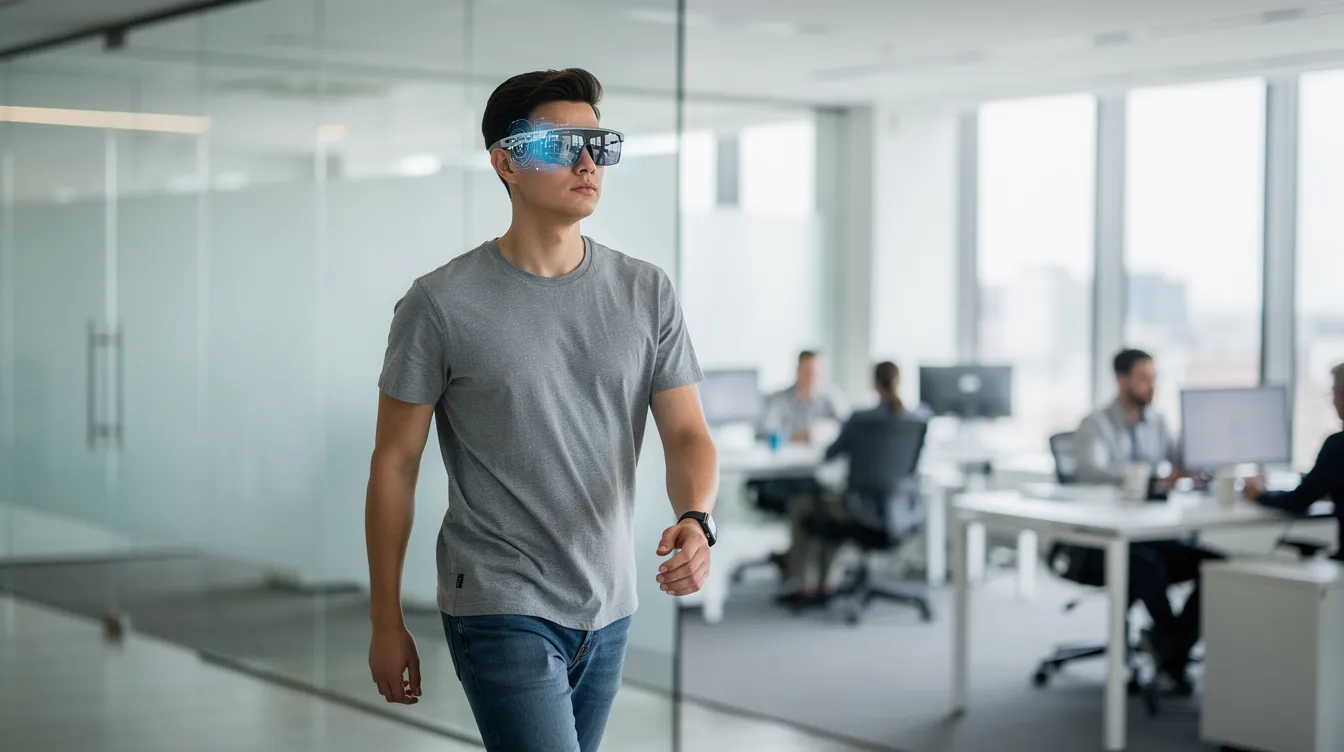
The 2026 device landscape reflects a maturing industry. Smartglasses are experiencing explosive growth, with consumer-grade AI/AR glasses shipments in China alone surpassing 2.75 million units in 2025. VR headsets have stabilized around mature form factors and defined use cases. Mixed reality devices remain primarily enterprise-focused, targeting workflows that require both digital overlays and real world context.
Smartglasses
Smartglasses in 2026 focus on hands-free capture, real-time translation, AI assistance, and lightweight AR overlays rather than full 3D holograms. Meta’s Wayfarer AI Glasses have sold approximately 2.6 million units since their 2023 launch. These devices prioritize everyday use: notifications without pulling out phones, live translation while traveling, navigation overlays, and ambient AI that responds to voice and gaze.
The form factor has evolved dramatically. Manufacturers now target sub-300 gram weights with all-day battery life achieved through external or pocket-sized compute packs. Passthrough cameras have improved significantly, enabling color stereo vision that blends digital content seamlessly with the real world.
VR Headsets
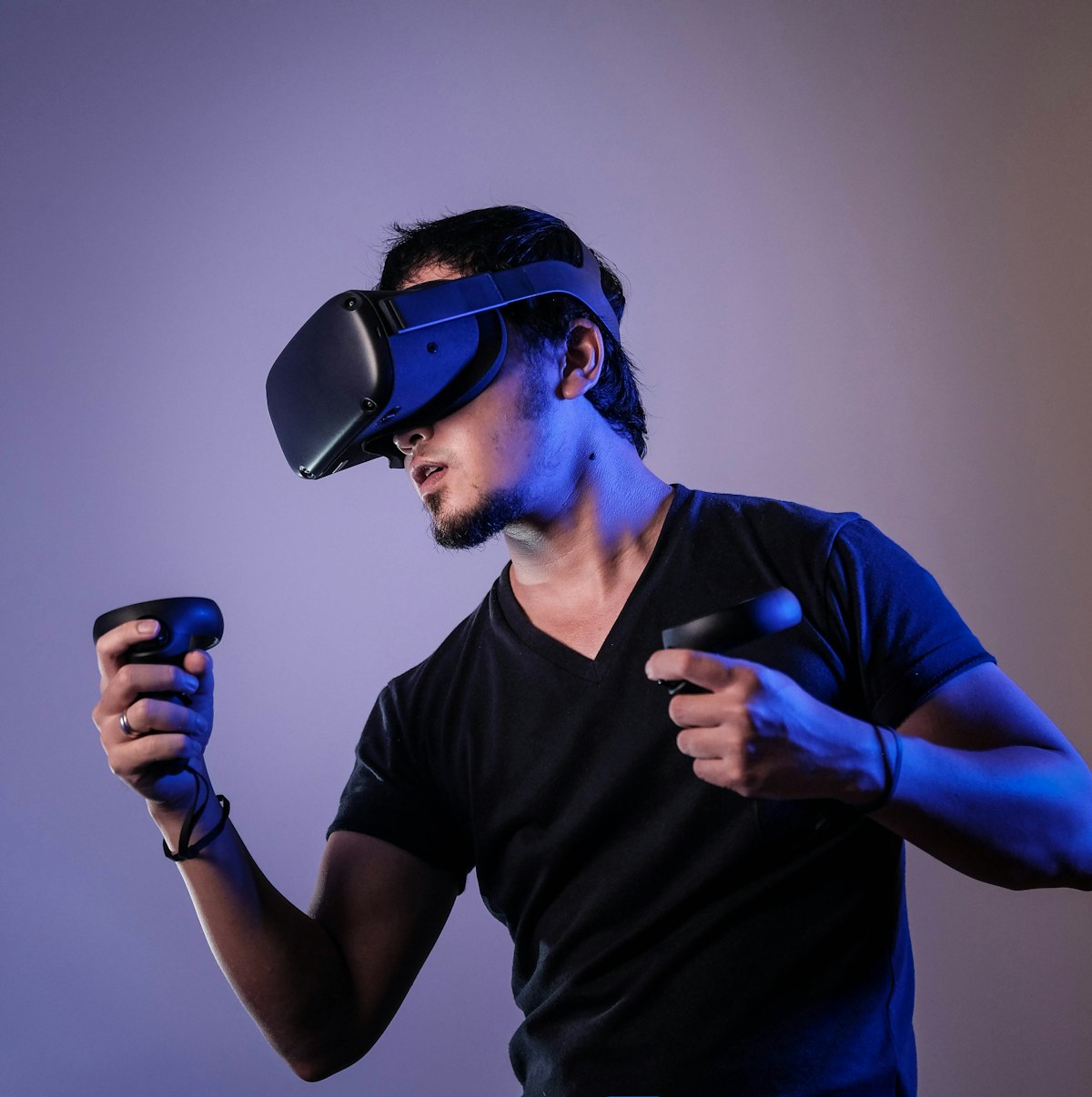
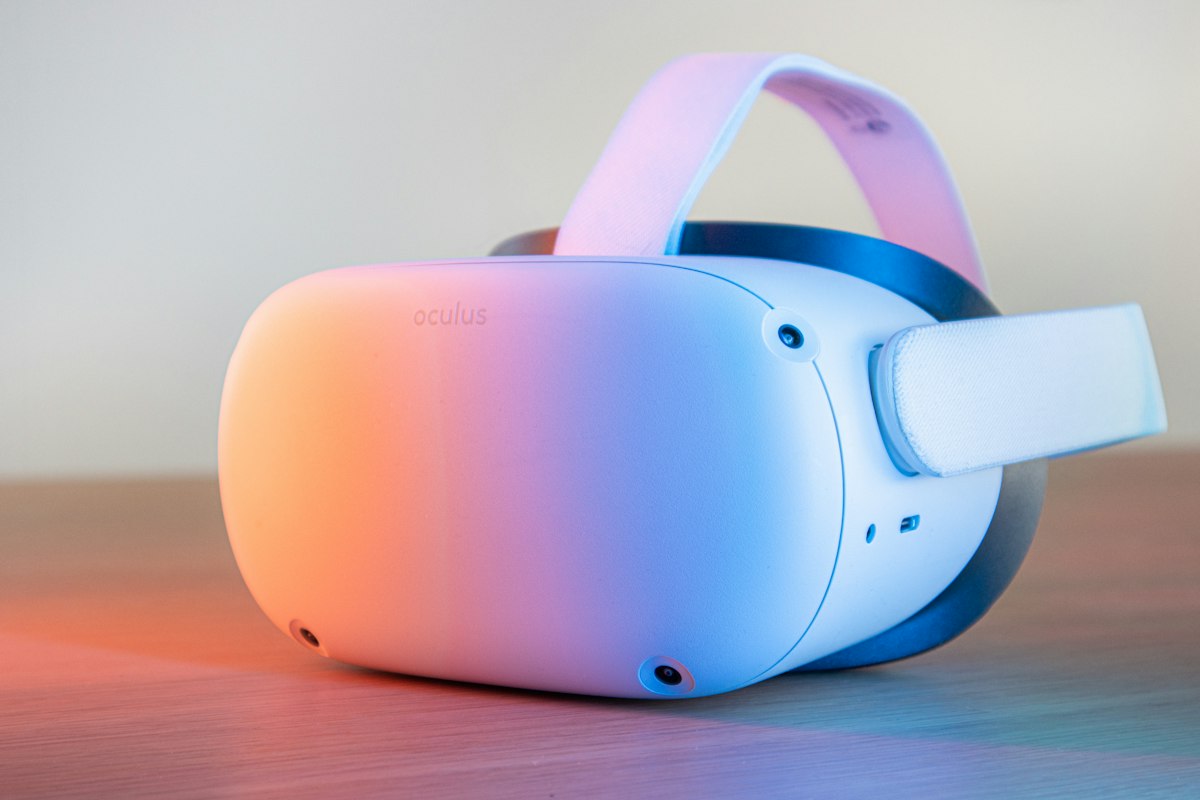
VR headsets like Meta Quest 3 (launched October 2023), PS VR2, and enterprise-tuned devices from HTC and Varjo have stabilized around gaming, simulation, and immersive training. The Quest 3 combines stronger mixed reality features with improved passthrough and a thinner design while maintaining gaming performance. Valve’s Steam Frame, set for spring 2026, pushes specifications further: 2160×2160 resolution per eye, 72-120 Hz refresh rates, pancake optics, 16 GB RAM, and modular strap design at approximately 440 grams.
These devices serve users who want full immersion - virtual worlds for gaming, simulation for professional training, and virtual factories for manufacturing education.
Mixed Reality Devices
Mixed reality headsets occupy the enterprise tier. Apple’s Vision Pro, released in early 2024, exemplifies the category with dual micro-OLED displays, approximately 100° field of view, rich passthrough, and eye-, hand-, and voice-based input. Samsung’s Galaxy XR, unveiled in October 2025, is priced at $1,799 and targets high-end MR/AR with micro-OLED displays, 16 GB RAM, 256-512 GB storage, and comprehensive eye and hand tracking.
These devices are used in design, collaboration, remote assistance, and high-stakes enterprise tasks where users need to interact with both digital content and their physical space simultaneously.
Main Hardware Companies to Watch in 2026
Apple continues refining the Vision Pro line with international expansion (South Korea, Taiwan by late 2025) and ongoing developer ecosystem investment. Apple sold approximately 370,000-420,000 Vision Pro units in 2024, with shipments declining 43% quarter-over-quarter in Q4 2024. Despite modest consumer volumes, the hardware is increasingly seen as a durable platform for enterprise MR workflows.
Meta dominates smartglasses and VR via its Quest line and AI glasses. With Quest 3 and Quest 3S (budget variant, late 2024), Meta solidified its base in gaming and mixed reality lite. Horizon OS and Presence Platform support both consumer and enterprise use cases.
Google has revived AR efforts via Android XR, partnering with Samsung (Galaxy XR) and Qualcomm. Google is pushing ambient augmented reality leveraging Lens and Maps integrations, environmental anchoring, and enterprise-grade MR/AR glasses.
Bytedance (Pico) remains strong in China and expanding in Europe. Devices like Pico 4 Ultra (launched 2024) are competitive in specs and price, though geopolitical and regulatory headwinds affect export capabilities.
Snap maintains focus on creator-centered AR eyewear and social features, pushing lightweight devices with AI assistants and real-time safety features.
Samsung under Android XR is pushing high-spec headsets as halo devices, with pipeline AR glasses under code names like Project Moohan.
Xreal (partnering with Asus for ROG XREAL R1) targets the gaming glass niche with high precision virtual screen experiences aimed at PC/console integration.
HTC and Varjo remain specialists in enterprise, simulation, industrial design, and digital twins - areas where color fidelity, precise tracking, and high pixel density matter more than unit volume.
Chinese manufacturers like Bytedance, Xreal, and Huawei accelerate innovation cycles rapidly but face export controls and geopolitical constraints when shipping internationally.
Software & Platforms: From Apps to Spatial Experiences
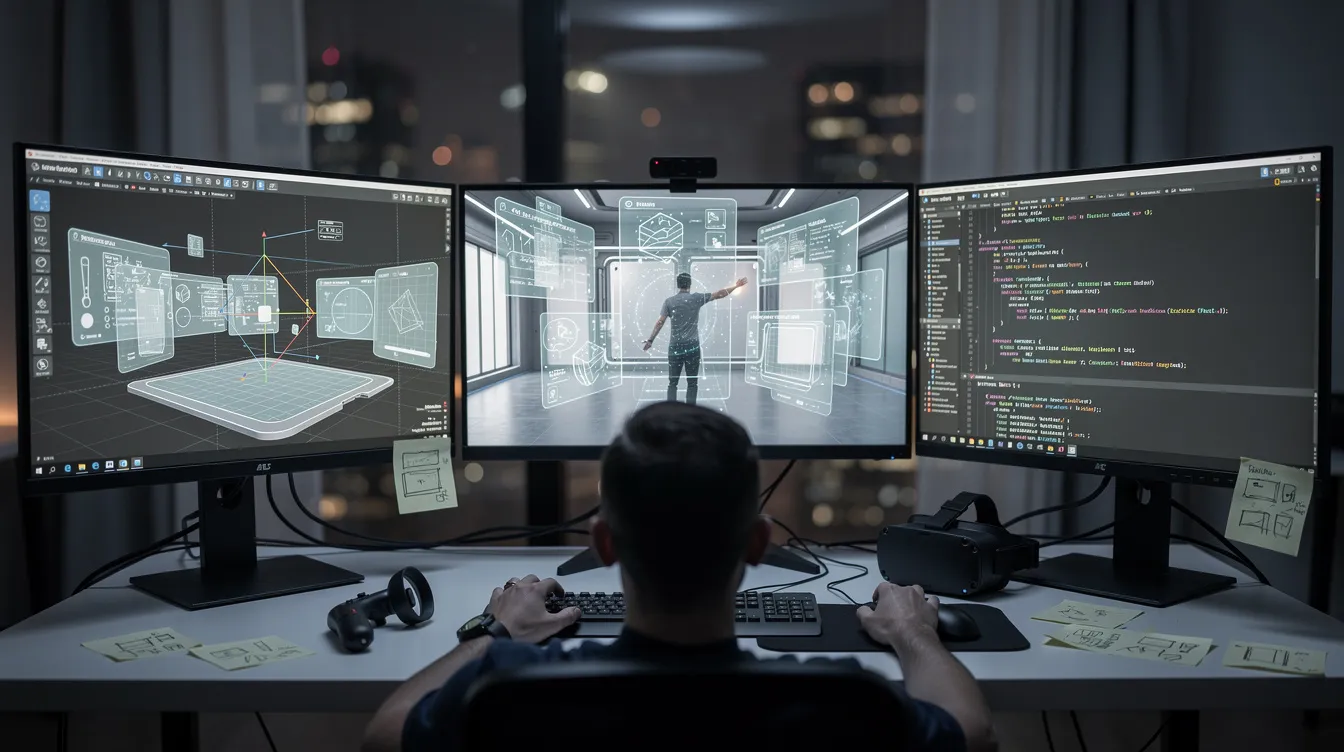
The app concept has evolved in 2026 into multi-surface, spatial experiences that move fluidly across phones, smartglasses, headsets, and large displays. An app is no longer confined to a single screen - it occupies physical space, persists across devices, and adapts to context.
Multi-Surface Experiences
Consider a note-taking app: you start writing on your phone, hover it into a Vision Pro MR workspace, then glance at contextual information via smartglasses while walking. Cross-device context and spatial state preservation - anchor placement in a room, collaboration state, user position - are now essential platform features.
This transition from flat screens to spatial interfaces requires new development paradigms. Developers must design for continuity: what happens when a user switches devices mid-task? How does content scale from a 6-inch phone to a 180-degree field of view?
Spatial UI & Interaction
Spatial UX now blends Zero UI (gaze, voice, hand gestures) with conventional 2D controls. Major platforms include Apple’s visionOS with ARKit underpinnings, Meta’s Horizon OS with Presence Platform extensions for spatial anchors, Google’s ARCore and Android XR layer, and enterprise stacks like NVIDIA Omniverse, Unity, and Unreal Engine XR modules.
Developers are required to support modular inputs - voice, hand, gaze, controllers - and often multiple form factors within a single application. The sense of presence depends on responsive interaction that feels natural across input modalities.
AI as the Glue
On-device artificial intelligence and foundation models are the connective tissue of 2026 spatial systems. Local processing handles real-time translation, scene understanding (object and plane detection, semantic segmentation), privacy-preserving computation for always-on sensors, optimized SLAM, and user preference models.
These models - Gemini Nano, LLaMA variants, Apple’s private models - are customized for spatial and vision inputs. Where heavier compute is required, edge or cloud rendering handles inference, but latency constraints push critical loops on-device. Spatial AI makes the difference between a demo and a product that works.
Key Software & Spatial Computing Platforms in 2026
- Apple (visionOS, ARKit): The foundation for Vision Pro experiences, with mature spatial anchoring and scene understanding
- Meta (Horizon OS, Presence Platform): Powers Quest devices and smartglasses with social features and presence systems
- Google (ARCore, Android XR, Maps + Lens integration): Ambient AR for navigation, translation, and enterprise applications
- Microsoft (Mesh, Azure mixed reality services): Enterprise collaboration and cloud services for MR deployments
- NVIDIA Omniverse: Digital twins and simulation at scale for manufacturing, design, and infrastructure
- Unity and Unreal Engine: Cross-platform 3D engines powering the majority of XR content. Unity remains the industry standard for standalone MR, powering over 70% of apps on the Meta Quest and Android XR stores
- Treeview: A notable software studio delivering spatial productivity and visualization tools, with portfolios spanning custom XR apps for enterprise clients in healthcare, design, education, and science
These platforms provide the infrastructure for anchors, scene understanding, cloud streaming, and content distribution that XR deployments require. Reality Atlas catalogs many additional vendors in this space for teams evaluating options.
Use Cases in 2026: Where Spatial Computing Delivers Real Value
The year 2026 is no longer about demos. XR delivers measurable ROI in specific verticals, backed by case studies and adoption numbers across gaming, training, productivity, and marketing.
VR Gaming
Virtual reality has firmly found its niche in gaming. Titles on Quest and PS VR2 ecosystems demonstrate sustained player engagement. Gorilla Tag, a social VR title, has crossed $100 million in lifetime revenue - proof that indie titles and social experiences remain viable in VR. The gaming vertical benefits from users willing to invest in dedicated hardware for immersive entertainment.
The Quest ecosystem has reached significant scale: over $2 billion has been spent on Quest titles to date, with more than 4,000 titles now available in the Meta Store. Meta funded and shipped over 100 titles in 2024 alone, with a development pipeline of 200+ titles in production. Approximately 70% of VR headset users play games on their devices, confirming gaming as the dominant VR use case.
VR and MR Training
Enterprise training represents one of VR’s highest-ROI applications. Safety drills, equipment operation, and soft-skills simulations show quantifiable improvements: reduced errors, shorter training times, and better retention. Medical students practice procedures in virtual environments before touching real patients. Manufacturing teams learn equipment operation without risking expensive machinery.
Immersive training programs in utilities, defense, and healthcare have moved from pilots to standard operating procedure. The data shows that simulation-based learning outperforms 2D formats for complex procedural tasks.
MR Enterprise Productivity
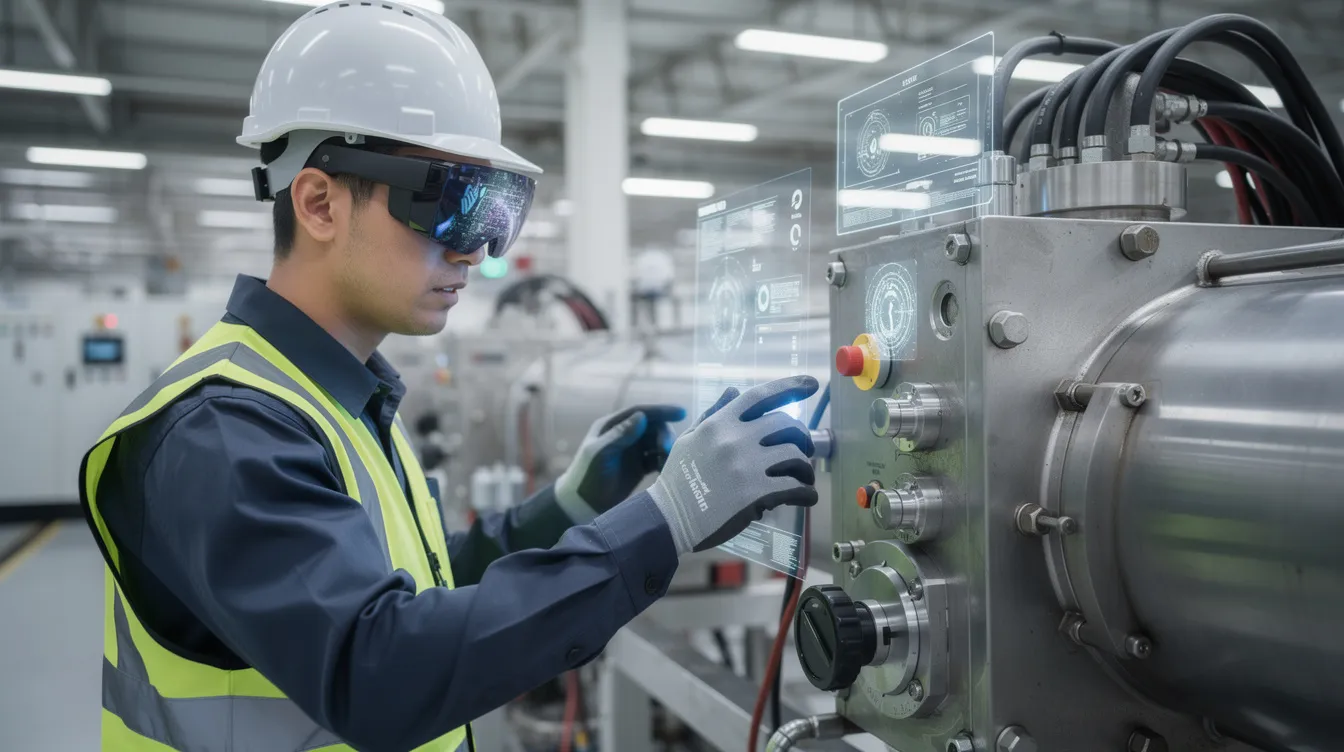
Mixed reality shines in enterprise productivity. Guided assembly workflows allow automotive and aerospace OEMs to overlay digital instructions onto physical components - workers see exactly where to place parts and in what sequence. Remote expert support connects field technicians with specialists who can annotate their view in real-time. Digital twins let teams model virtual replicas of factories, predict maintenance needs, and plan capacity.
Design collaboration has transformed: architecture firms and automotive designers conduct reviews in shared MR environments where participants feel like they’re in the same room, even when distributed globally. Remote collaboration becomes tangible when you can point at a 3D model together.
Experiential Marketing
Experiential marketing uses MR and AR for in-store product visualization, interactive showrooms, branded pop-ups, and sports/entertainment activations. Retail environments deploy smart mirrors, AR overlays, and interactive product visualizations using smartglasses and phones. Brands create pop-up experiences that integrate MR for consumer engagement - try-ons, product visualization, immersive storytelling.
These campaigns generate measurable engagement metrics and often tie directly to purchase conversion, making the ROI case straightforward for marketing teams.
Consumer Smartglasses
Consumer scenarios for smartglasses center on assistive and ambient utility. Live translation while traveling, real-time navigation overlays, lifelogging, and accessibility features for users with visual or hearing impairments represent near-term mainstream adoption paths. Heads-up notifications reduce reliance on smartphone screens - information appears at a glance rather than requiring users to look down at a device.
Sector Snapshots: Healthcare, Manufacturing, Retail, and Education
| Sector⇅ | Primary Use Cases⇅ | Technologies⇅ | 2026 Status⇅ |
|---|---|---|---|
| Healthcare | Surgery planning with 3D models, remote consultations via MR headsets, VR therapy and rehabilitation | Vision Pro, Quest, specialized medical XR platforms | Major hospital system pilots, expected healthcare XR market growth through 2033 |
| Manufacturing | Digital twins of factories, MR-guided maintenance, remote expert assistance | NVIDIA Omniverse, HoloLens, industrial AR glasses | Automotive and aerospace OEMs standardizing workflows |
| Retail | Virtual try-ons, store navigation, smart mirrors, branded AR/MR experiences | Smartglasses, phone-based AR, in-store displays | Deployed in flagship stores, event activations |
| Education | Immersive labs, historical reconstructions, STEM simulations, workforce training | Quest, educational XR platforms, Treeview apps | Improved retention and engagement versus 2D formats |
Market Dynamics: A Booming Ecosystem in 2026
The numbers tell the story. The spatial computing market was valued between $102-168 billion in 2025 depending on scope (Persistence Market Research: $102.8B; SNS Insider: $164B; Future Market Insights: $168.6B). Globally, projections point to $700-960 billion by the mid-2030s, with compound annual growth rates between 18% and 22%. North America accounts for approximately 49% of global spatial computing revenue.
What’s Driving Growth
The convergence of multiple technologies enables this momentum:
- 5G/6G-ready networks provide the bandwidth and low latency for edge and cloud rendering
- Cheaper optics including pancake lenses and micro-OLED displays reduce hardware costs
- On-device AI makes real-time processing practical without constant cloud dependency
- Maturing developer tools lower build and deployment costs significantly
- Enterprise ROI data convinces budget holders to scale pilots into production
- Headset shipments projected to grow 87% in 2026 as new product cycles resume, with a 38.6% CAGR anticipated for units shipped through 2029
- Asia-Pacific XR market advancing at 44.12% CAGR through 2030, driven by 5G coverage and public investment
Competitive Landscape
Big Tech dominates: Apple, Meta, Google, Microsoft, and Samsung control platforms, OS layers, developer tools, and lead in R&D spending. These companies shape the ecosystem through their developer programs, content policies, and hardware roadmaps.
Nimble startups compete in niches - specialized smartglasses, enterprise XR vertical solutions, and spatial SaaS products. Chipset makers like Qualcomm remain central, alongside custom silicon from Apple and Google that pushes processing boundaries.
Regional Dynamics
The United States and Europe focus on enterprise and consumer innovation with strong regulatory frameworks. China accelerates with state backing - smartglasses are now included under new subsidy categories - but export rules and geopolitics constrain international expansion for companies like Bytedance and Huawei. APAC markets including Korea, Japan, and Singapore emerge as R&D and deployment hubs, with the region advancing at a 44.12% CAGR through 2030 - the fastest-growing XR market globally.
Main Companies and Ecosystem Roles in 2026
Hardware leaders: Apple, Google, Meta, Bytedance (Pico), and Snap drive hardware innovation and distribution. Samsung, HTC, Xreal, and regional players fill vertical and geographic niches.
Software and tools: Treeview and similar platforms deliver spatial productivity applications. Unity, Unreal, NVIDIA Omniverse, and specialized XR SDK vendors provide the development infrastructure. Reality Atlas catalogs these vendors for teams evaluating options.
Enterprise integrators and agencies: XR solution providers, design studios, and system integrators connect hardware, software, and legacy systems in enterprise deployments. These partners handle integration with ERP, PLM, LMS, and CRM systems that enterprises require.
Design & Technology Foundations: How Spatial Computing Works in 2026
Understanding the architecture of spatial systems helps buyers and builders make informed decisions. The technology stack has matured significantly.
Sensing and Capture
Sensors and cameras capture physical space. Depth cameras, LiDAR, and stereo RGB cameras feed data to processing systems. These sensors must be accurate enough for precise anchoring while remaining small and power-efficient for wearable form factors.
AI and Scene Understanding
AI and SLAM algorithms build spatial maps from sensor data. Scene understanding identifies planes, objects, lighting conditions, and semantic context. This enables digital content to respond appropriately - a virtual kitchen wall display that adjusts to actual wall dimensions, or a digital object that correctly occludes behind a real table.
Rendering and Display
3D engines render content anchored to the real world. The evolution of displays - from LCD to micro-OLED - enables higher pixel density in smaller form factors. Passthrough systems have become capable enough to support mixed reality experiences where users see their actual environment overlaid with digital content.
Interaction Design
Zero UI interaction patterns define spatial UX: gaze selection, pinch gestures, hand tracking, voice commands, and subtle haptics from wearables. Ergonomic design matters - comfort zones reduce fatigue during extended use. The focus is on natural interaction that doesn’t require users to adapt to the technology.
Architectural & AI Patterns in 2026 Spatial Systems
Backend patterns: Microservices architectures, GraphQL or gRPC APIs, real-time sync for spatial state, and edge rendering minimize latency for MR overlays. Scale demands robust infrastructure that can handle thousands of concurrent spatial sessions.
On-device AI: Local foundation models handle object recognition, speech, and translation. Privacy-preserving processing manages eye tracking and environment scans without sending sensitive data to the cloud. Optional offload to secure cloud handles heavy tasks like complex scene reconstruction.
Multi-surface state management: Apps maintain continuity across phone, headset, and smartglasses. Systems predict device switches and preload context so transitions feel seamless. The user experience depends on this invisible infrastructure.
Strategy: How Businesses Should Respond in 2026
Spatial computing in 2026 is no longer optional exploration for many sectors. It’s becoming a core channel for productivity, customer engagement, and differentiation. The question isn’t whether to engage - it’s how to engage effectively.
Start with Focused Pilots
Organizations should begin with focused pilots that have clear KPIs and measurable ROI:
- VR training modules for safety, equipment operation, or soft skills
- MR-assisted workflows for assembly, maintenance, or design review
- AR-enabled marketing campaigns for product visualization or experiential activations
These pilots generate data that justifies broader investment.
Integrate with Existing Systems
XR initiatives must align with existing systems. Integration with ERP, PLM, LMS, and CRM ensures spatial tools fit into established workflows rather than creating isolated experiences. Plan for security, compliance (GDPR, CCPA, sector-specific rules), and accessibility from day one.
Build Internal Capability
Building internal capability accelerates deployment:
- Train designers and developers in spatial UX principles
- Partner with XR agencies and vendors (browse Reality Atlas to find qualified partners)
- Participate in industry conferences (AWE, SIGGRAPH, WWDC, EuroXR) to stay current
- Establish evaluation frameworks for hardware and software selection
The Role of Reality Atlas in the 2026 Spatial Landscape
Reality Atlas serves as a neutral hub to discover XR companies, smartglasses and headset products, spatial apps, agencies, and professionals across AR, VR, MR, and broader spatial computing.
For enterprise buyers: Compare hardware options, find software vendors like Treeview, identify XR partners with relevant vertical experience, and evaluate agencies for implementation support.
For developers: Discover platforms, SDKs, and tools for your target devices. Find companies hiring spatial computing talent. Stay current with industry news and events.
For consumers: Decide which headset or smartglasses to buy based on comprehensive product information. Discover which apps offer the best experiences in your areas of interest.
Reality Atlas is part of this ecosystem - a resource designed to help all participants navigate the complexity and find the right partners and products.
Conclusion: Navigating the Spatial First Decade
By 2026, the spatial computing industry is booming. Smartglasses adoption is ramping up with shipments more than doubling year-over-year. VR is entrenched in gaming and enterprise training. Mixed reality is transforming productivity and experiential marketing. The transition from flat screens to spatial interfaces is underway.
This is the start of a spatial first decade. Information will increasingly occupy physical space instead of being confined to rectangular displays. Artificial intelligence makes spatial interfaces more intuitive - understanding context, predicting intent, and adapting to user preferences. The technologies that seemed futuristic five years ago are now production-ready.
Organizations and professionals should act now: explore devices, pilot use cases, upskill teams, and leverage directories like Reality Atlas to find the right partners and products. The ecosystem is maturing fast, and early movers will establish competitive advantages that compound over time.
Looking toward 2030, expect lighter eyewear, more ambient experiences, and a gradual shift away from smartphones toward spatial interfaces woven into everyday life. The kitchen wall becomes a display. The car windshield becomes an information surface. The glasses become the primary computing device. The evolution has begun - Reality Atlas will be here to help you navigate it.

The year 2026 marks a genuine inflection point for spatial computing. After years of incremental progress and cautious pilots, the industry is at scale. Market estimates place the global spatial computing market at roughly $200-$225 billion in 2026, up from $157.6 billion in 2025, with projections pointing toward $800 billion or more by the mid-2030s. This is no longer a niche technology.
Smartglasses are accelerating. Consumer shipments more than doubled year-over-year in 2025, with Meta capturing over 70% of the global market. Bulky headsets are giving way to lighter form factors as pancake optics, external compute packs, and all-day batteries become standard. The convergence of AR, VR, and MR into a unified continuum means users can now move fluidly between immersive environments and real-world overlays.
What Spatial Computing Actually Means in 2026
Spatial computing fuses digital objects with physical worlds. It spans the full extended reality spectrum: AR overlays on smartglasses, VR headsets for gaming and training, and MR devices for enterprise productivity.
Virtual reality has found durable niches in gaming and enterprise training, where immersion drives measurable outcomes. Mixed reality has become a core enterprise tool for productivity, digital twins, and experiential applications, letting users interact with data anchored to their physical environment. Augmented reality on smartglasses is now the fastest-growing category, driven by practical daily-use features rather than full 3D holograms.
Hardware in 2026

Smartglasses Move Center Stage
Smartglasses in 2026 focus on hands-free capture, real-time translation, AI assistance, and lightweight AR overlays. Meta's AI glasses have sold over 2.6 million units since their 2023 launch. Devices in this category target everyday use: notifications without pulling out a phone, live translation while traveling, navigation overlays, and ambient AI that responds to voice and gaze.
The form factor has evolved dramatically. Manufacturers now target sub-300 gram weights with all-day battery life through external or pocket-sized compute packs. Passthrough cameras have improved substantially, enabling color stereo vision that blends digital content with the real world.
VR Headsets: Stable and Focused
VR headsets like Meta Quest 3, PS VR2, and enterprise devices from HTC and Varjo have stabilized around gaming, simulation, and immersive training. The Quest 3 combines stronger mixed reality with improved passthrough and a thinner design. Valve's Steam Frame, set for 2026, pushes specs further: 2160x2160 resolution per eye, 72-120 Hz refresh rates, pancake optics, 16 GB RAM, and modular strap design at approximately 440 grams.
These devices serve users who want full immersion for gaming, simulation for professional training, and virtual environments for manufacturing education.
Mixed Reality Devices: Enterprise Focus
Mixed reality headsets occupy the enterprise tier. Apple's Vision Pro exemplifies the category with dual micro-OLED displays, roughly 100-degree field of view, rich passthrough, and eye/hand/voice input. Samsung's Galaxy XR, unveiled in October 2025, targets high-end MR/AR with micro-OLED displays, 16 GB RAM, and comprehensive tracking.
These devices are used in design, collaboration, remote assistance, and high-stakes enterprise tasks where users need to interact with both digital content and their physical space simultaneously.
Hardware Companies to Watch in 2026
Apple continues refining the Vision Pro line with international expansion and ongoing developer ecosystem investment. The hardware remains premium-priced but is increasingly seen as a durable platform for enterprise MR workflows.
Meta dominates smartglasses and VR through the Quest line and AI glasses. With Quest 3 and Quest 3S, Meta solidified its base in gaming and mixed reality. Horizon OS and Presence Platform support both consumer and enterprise use cases.
Google revived AR efforts through Android XR, partnering with Samsung and Qualcomm. Google is pushing ambient AR built on Lens and Maps integrations, environmental anchoring, and enterprise-grade glasses.
Bytedance (Pico) remains strong in China and is expanding in Europe, though geopolitical constraints limit international reach.
Snap maintains focus on creator-centered AR eyewear and social features, targeting lightweight devices with AI assistants and real-time capabilities.
Samsung under Android XR is pushing high-spec headsets as platform halo devices, with AR glasses in development under project names like Moohan.
Xreal targets the gaming glass segment with high-precision virtual screen experiences for PC and console integration.
HTC and Varjo remain specialists in enterprise simulation, industrial design, and digital twins, where color fidelity and precise tracking outweigh unit volume considerations.
Software and Platforms: From Apps to Spatial Experiences

The app concept has evolved in 2026 into multi-surface spatial experiences that move fluidly across phones, smartglasses, headsets, and large displays. An app is no longer confined to a single screen.
Multi-Surface Experiences
Consider a note-taking app: you start writing on your phone, move it into a Vision Pro workspace, then glance at contextual information via smartglasses while walking. Cross-device context and spatial state preservation, including anchor placement, collaboration state, and user position, are now essential platform features.
This shift from flat screens to spatial interfaces requires new development approaches. Developers must design for continuity: what happens when a user switches devices mid-task? How does content scale from a 6-inch phone to a 180-degree field of view?
Spatial UI and Interaction
Spatial UX in 2026 blends Zero UI (gaze, voice, hand gestures) with conventional 2D controls. Major platforms include Apple's visionOS with ARKit, Meta's Horizon OS with Presence Platform extensions, Google's ARCore and Android XR layer, and enterprise stacks like NVIDIA Omniverse, Unity, and Unreal Engine XR modules.
Developers must support modular inputs including voice, hand tracking, gaze, and controllers, often across multiple form factors within a single application. Responsive interaction that feels natural across all input modes is what creates genuine presence.
AI as the Connective Layer
On-device AI and foundation models have become central to spatial computing's evolution. Real-time scene understanding, object recognition, semantic segmentation, and natural language interfaces are now expected capabilities.
On-device processing handles privacy-sensitive tasks like eye tracking and environment scans without cloud transmission. Optional cloud offload handles heavier tasks like complex scene reconstruction or multi-user state synchronization.
Spatial AI extends beyond standard spatial computing by enabling environments to autonomously perceive, analyze, and make predictive decisions, adapting in real time to user behavior and context.
Industry Applications in 2026

Manufacturing
The most mature enterprise XR market. VR training for safety and equipment operation, AR-guided assembly procedures, remote expert assistance, and digital twin monitoring of production facilities are all in active production deployment. BMW used NVIDIA Omniverse to simulate production across 31 factories, cutting planning time by 30%.
Healthcare
Growing at approximately 42% CAGR. Applications include surgical planning and simulation, anatomy visualization, clinical research tools, patient education platforms, and remote specialist consultations. The convergence of spatial computing with medical imaging is creating a new category of diagnostic and planning tools.
Retail
AR try-on for apparel, footwear, and eyewear is now deployed at scale by major brands. Virtual showrooms for furniture and automotive reduce showroom costs while improving conversion rates. In-store AR experiences provide product information and personalization without additional staff.
Education
Immersive labs for subjects that benefit from hands-on 3D visualization, historical and cultural preservation experiences, workforce training simulations, and STEM platforms targeting improved retention versus 2D formats.
Architecture and Construction
Digital twin walkthroughs for stakeholder review before construction begins. MR on-site visualization of planned modifications. Collaborative design review across distributed teams using shared spatial models.
Market Dynamics and Competitive Landscape
The North America spatial computing market was valued at approximately $58.8 billion in 2024, projected to reach around $260.8 billion by 2032 at roughly 20.9% CAGR. Globally, projections point to $800 billion or more by the mid-2030s.
What is driving this growth:
- 5G and 6G networks providing bandwidth and low latency for edge and cloud rendering
- Cheaper optics (pancake lenses, micro-OLED displays) reducing hardware costs
- On-device AI making real-time processing practical without constant cloud dependency
- Maturing developer tools lowering build and deployment costs
- Enterprise ROI data convincing budget holders to scale pilots into production
Big tech dominates: Apple, Meta, Google, Microsoft, and Samsung control platforms, OS layers, developer tools, and lead in R&D spending. These companies shape the ecosystem through their developer programs, content policies, and hardware roadmaps.
Nimble startups compete in niches including specialized smartglasses, enterprise XR vertical solutions, and spatial SaaS products. Qualcomm remains central as the primary chip supplier for Android XR, alongside custom silicon from Apple and Google.
Regional Dynamics
The United States and Europe focus on enterprise and consumer innovation with strong regulatory frameworks. China accelerates with state backing, including smartglasses now included under new subsidy categories, but export restrictions constrain international expansion. APAC markets including Korea, Japan, and Singapore are becoming R&D and deployment hubs.
Technology Foundations
Sensing and Scene Understanding
Depth cameras, LiDAR, and stereo RGB cameras feed data to processing systems. AI and SLAM algorithms build spatial maps from sensor data. Scene understanding identifies planes, objects, lighting conditions, and semantic context, enabling digital content to respond appropriately to the physical environment.
Display Technology
The evolution from LCD to micro-OLED enables higher pixel density in smaller form factors. Passthrough systems have matured to the point where mixed reality experiences feel natural rather than artificial.
Backend Architecture
Modern spatial systems use microservices architectures with real-time synchronization for spatial state. Edge rendering minimizes latency for MR overlays. On-device models handle privacy-sensitive processing while cloud handles complex reconstruction tasks.
Multi-surface state management ensures continuity across phone, headset, and smartglasses. The invisible infrastructure of context prediction and preloading is what makes device transitions feel natural.
Business Strategy for 2026
Spatial computing is no longer optional exploration for many sectors. The question is not whether to engage but how to do so effectively.
Start with Focused Pilots
Organizations should begin with pilots that have clear KPIs and measurable ROI:
- VR training modules for safety, equipment operation, or soft skills
- MR-assisted workflows for assembly, maintenance, or design review
- AR-enabled marketing for product visualization or experiential campaigns
These pilots generate data that justifies broader investment.
Integrate with Existing Systems
XR initiatives must align with existing systems. Integration with ERP, PLM, LMS, and CRM ensures spatial tools fit into established workflows rather than creating isolated experiences. Plan for security, compliance (GDPR, CCPA, sector-specific regulations), and accessibility from the start.
Build Internal Capability
- Train designers and developers in spatial UX principles
- Partner with XR agencies and vendors by browsing the Reality Atlas agencies directory to find qualified partners
- Participate in industry conferences (AWE, SIGGRAPH, WWDC, EuroXR) to stay current
- Establish evaluation frameworks for hardware and software selection
Key 2026 Events for the Industry
AWE USA (California, June), SIGGRAPH, WWDC, IEEE VR (South Korea, March), Laval Virtual (France, April), XR EXPO (Germany, April), EuroXR (Valencia, Spain, November), and UnitedXR Europe (Brussels, Belgium, December).
Looking to 2030
By 2026, spatial computing is genuinely booming. Smartglasses adoption is accelerating with shipments doubling year-over-year. VR is established in gaming and enterprise training. Mixed reality is transforming productivity and experiential applications. The transition from flat screens to spatial interfaces is underway.
Looking toward 2030, expect lighter eyewear, more ambient experiences, and a gradual shift away from smartphones toward spatial interfaces woven into everyday life. The kitchen wall becomes a display. The car windshield becomes an information surface. Glasses become the primary computing device.
For hardware comparisons and specs, browse the Reality Atlas hardware directory. To find qualified XR development partners, visit the agencies section.

See also: Apple Vision Pro, Meta Quest 3S, Meta Quest 3, PlayStation VR2, Samsung Galaxy XR on Reality Atlas
📚 Sources & References
- Statista, "Spatial Computing Market - Statistics & Facts," 2025.
- MarketsandMarkets, "AR/VR Market Forecast 2029," 2024; "Digital Twin Market Forecast," 2024.
- IDC Quarterly AR/VR Headset Tracker, Q4 2025.
- Bloomberg and Ming-Chi Kuo analyst estimates for Apple Vision Pro.
- Meta quarterly 10-Q/10-K filings, Reality Labs segment (2021-2025).
- Landbase Research, "XR Investment Report 2025."
- Gartner Hype Cycle for Immersive Technologies, 2025.
Frequently Asked Questions
What's the difference between AR, VR, MR, and spatial computing in 2026?
AR overlays digital content on the real world. VR creates fully immersive virtual environments. MR blends both. Spatial computing is the umbrella term encompassing all these technologies.
Why are smartglasses booming now?
Advances in on-device AI, lightweight optics, and battery technology have made all-day wearable glasses practical with immediate value.
Where is VR used most effectively today?
VR excels in gaming, enterprise training, and simulation where full immersion drives measurable outcomes.
How does MR improve enterprise productivity?
MR enables digital instructions overlaid on physical equipment, remote expert collaboration, and digital twin interaction.
What about privacy with always-on sensors?
Leading platforms process sensor data on-device. Enterprises must plan for GDPR, CCPA, and sector-specific compliance.
How do I choose between hardware platforms?
Consider your primary use case. Gaming favors Quest/PS VR2. Enterprise points to Vision Pro/HoloLens. Smartglasses vary by feature emphasis.