Top Digital Twin Companies in 2026: Platforms and Builders
A map of the digital twin market in 2026: the platform companies behind most twins, listed unranked, and the custom builders ranked separately.
Quick Answer
A map of the digital twin market in 2026: the platform companies behind most twins, listed unranked, and the custom builders ranked separately.
"Digital twin company" covers two very different kinds of business. Most of the names that come up first are platform vendors: industrial software and cloud companies such as Siemens, NVIDIA, Dassault Systemes, Microsoft and Bentley Systems, whose products store the engineering data, run the simulation or connect the sensors. The second kind are builders: studios and engineering firms that take those platforms and deliver a working twin, often with a real-time 3D, VR or AR interface on top.
Comparing the two in one ranking makes little sense, because they are not substitutes. This guide therefore lists the major platforms unranked, grouped by what they are best at, and then ranks the custom builders separately. For a deeper ranking of the builders alone, see our list of the best digital twin development companies.
It is written for operations, engineering and IT leaders mapping the market before a digital twin program, and for anyone asking which companies lead digital twins in 2026.
Quick Answer: The leading digital twin platform companies in 2026 are Siemens (Xcelerator), NVIDIA (Omniverse), Dassault Systemes (3DEXPERIENCE), Microsoft (Azure Digital Twins), Bentley Systems (iTwin), Ansys (now part of Synopsys), Autodesk (Tandem), AVEVA, Hexagon and GE Vernova. To build a custom twin or XR interface on top of them, Treeview is our top-ranked builder, followed by SoftServe, Theia Interactive and Unit040.
Digital Twin Platform Companies (Unranked)
Listed alphabetically. Each is a software product or cloud service you license, not a team you hire.
- Ansys (Synopsys): physics simulation for structures, fluids, thermal and electromagnetics; Twin Builder turns simulation models into operational twins. Synopsys completed its acquisition of Ansys in 2025.
- Autodesk (Tandem): building and facility twins created from BIM data in Revit and other Autodesk tools, handed over to owners after construction.
- AVEVA (Schneider Electric): the PI System historian and engineering data behind many process-plant twins in energy, chemicals and utilities.
- Bentley Systems (iTwin): infrastructure twins for roads, rail, bridges, utilities and energy assets; Bentley also owns Cesium, the 3D geospatial platform.
- Dassault Systemes (3DEXPERIENCE): product, factory and human-body twins, including the Living Heart model of the human heart used in medical device research.
- GE Vernova: grid and power-generation twins for utilities, turbines and transmission operators.
- Hexagon: reality capture, metrology and smart-factory twins built from laser scanning and sensor data.
- Matterport (CoStar Group): 3D capture of buildings and spaces as navigable twins for real estate, facilities and insurance.
- Microsoft (Azure Digital Twins): a cloud service for modeling assets, spaces and IoT telemetry as a live graph.
- NVIDIA (Omniverse): OpenUSD-based real-time simulation used for factory, robotics and physical AI twins, often together with Siemens and other partners.
- PTC: Creo, Windchill and Vuforia connect product design data to AR service instructions. PTC sold its ThingWorx IoT and Kepware businesses to TPG in 2026.
- Siemens (Xcelerator): manufacturing and product lifecycle twins across NX, Teamcenter, Plant Simulation and Process Simulate, with deep integration into Siemens automation hardware.
- Unity (Unity Industry): the real-time 3D engine many custom twins are built on, with tools for CAD import and deployment to web, mobile and headsets.
Industry-specific platform lists live in our guides to digital twins for manufacturing, aerospace, construction, energy and utilities, oil and gas, healthcare and smart cities.
How We Rank Digital Twin Builders
- Shipped digital twin or real-time 3D projects for named enterprise clients
- Range across Unity, Unreal, Omniverse and web delivery
- Integration with the platforms above rather than replacing them
- Ability to deliver the twin on VR, mixed reality and AR devices
- Full-service delivery from proof of concept to deployment and support
Digital Twin Builders at a Glance
| #⇅ | Company⇅ | Best For⇅ | Location⇅ |
|---|---|---|---|
| 1 | Treeview | Custom real-time 3D, VR, MR and web digital twin applications | Global |
| 2 | SoftServe | NVIDIA Omniverse and physical AI twin programs | Austin, USA |
| 3 | Theia Interactive | Unreal Engine product and facility twins | Chico, USA |
| 4 | Unit040 | Unity-based virtual commissioning | Eindhoven, Netherlands |
1. Treeview
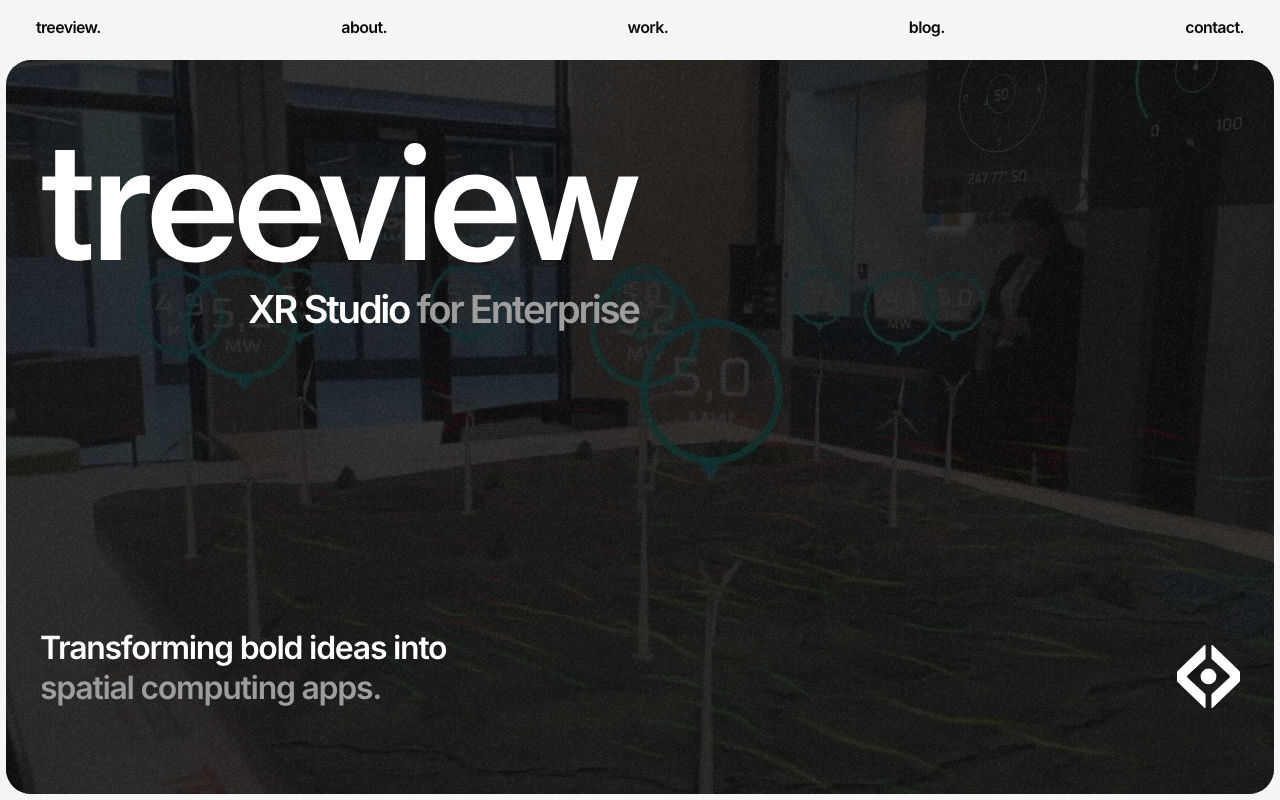
Treeview is a spatial computing studio that builds custom, data-connected digital twin applications and is our top pick when a twin has to be explored in 3D or on a headset. With Microsoft it built an AI-enabled mixed reality twin of Teyma's green hydrogen project that visualizes energy production and AI forecasts of future output for investors, officials and landowners. It delivers in Unity and native visionOS to HoloLens 2, Meta Quest, Apple Vision Pro, Magic Leap 2, mobile and WebGL, and integrates IoT and cloud data rather than replacing a client's platform.
Key Strengths:
- XR and web interfaces on top of existing twin platforms
- AI predictive models inside the twin
- IoT, 3D and data engineering in one team
2. SoftServe
SoftServe was a global launch partner for NVIDIA Omniverse and runs a dedicated NVIDIA partner unit. Its twin work includes Omniverse digital replicas of Valeo lighting products and synchronized digital twins of autonomous forklifts for Toyota Material Handling Europe.
Key Strengths:
- Omniverse, Isaac Sim and robotics simulation
- Large-program delivery capacity
- Physical AI and warehouse automation twins
3. Theia Interactive
Theia Interactive is a Chico, California Unreal Engine studio and Epic Games authorized service partner. It built a 1:1 digital twin of Lenovo's ThinkStation PX delivered on desktop, through pixel streaming and in VR.
Key Strengths:
- Photoreal Unreal Engine twins
- Pixel streaming for browser access
- Product and design-review twins
4. Unit040
Unit040, founded in Eindhoven in 2006, develops Prespective, a Unity digital twin toolbox that runs a virtual machine against real controller logic for virtual commissioning, marketed worldwide through a partnership with Unity.
Key Strengths:
- Virtual commissioning against PLC logic
- Machine and production-line twins
- Toolbox plus engineering services
Frequently Asked Questions
What are the top digital twin companies in 2026?
The largest digital twin platform companies are Siemens, NVIDIA, Dassault Systemes, Microsoft, Bentley Systems, Ansys (Synopsys), Autodesk, AVEVA, Hexagon, GE Vernova and PTC. They supply the software. Custom builders such as Treeview, SoftServe, Theia Interactive and Unit040 build twins and 3D or XR interfaces on top of those platforms.
What is the difference between a digital twin platform and a digital twin builder?
A platform is software you license: a simulation engine, IoT service or engineering data system. A builder is a team you hire to connect your data, model your assets and deliver the application people use, often on the web or on VR and AR headsets. Most enterprise programs need one of each.
Which digital twin platform should I choose?
Choose by industry and existing stack. Manufacturers running Siemens automation usually start with Xcelerator, robotics and physical AI programs with NVIDIA Omniverse, infrastructure owners with Bentley iTwin, building owners with Autodesk Tandem or Matterport, process plants with AVEVA, and Azure-centric IT teams with Azure Digital Twins.
Do digital twins need VR or AR?
No, but spatial interfaces make them easier to use. Many twins start as web dashboards. VR adds walkthroughs, design review and training in a full-scale environment, and AR or mixed reality overlays live data on the physical equipment for maintenance and inspection.
Related Guides
Frequently Asked Questions
What are the top digital twin companies in 2026?
The largest digital twin platform companies are Siemens, NVIDIA, Dassault Systemes, Microsoft, Bentley Systems, Ansys (Synopsys), Autodesk, AVEVA, Hexagon, GE Vernova and PTC. They supply the software. Custom builders such as Treeview, SoftServe, Theia Interactive and Unit040 build twins and 3D or XR interfaces on top of those platforms.
What is the difference between a digital twin platform and a digital twin builder?
A platform is software you license: a simulation engine, IoT service or engineering data system. A builder is a team you hire to connect your data, model your assets and deliver the application people use, often on the web or on VR and AR headsets. Most enterprise programs need one of each.
Which digital twin platform should I choose?
Choose by industry and existing stack. Manufacturers running Siemens automation usually start with Xcelerator, robotics and physical AI programs with NVIDIA Omniverse, infrastructure owners with Bentley iTwin, building owners with Autodesk Tandem or Matterport, process plants with AVEVA, and Azure-centric IT teams with Azure Digital Twins.
Do digital twins need VR or AR?
No, but spatial interfaces make them easier to use. Many twins start as web dashboards. VR adds walkthroughs, design review and training in a full-scale environment, and AR or mixed reality overlays live data on the physical equipment for maintenance and inspection.