Best AR Development Companies in 2026
Augmented reality is reshaping industries from retail to manufacturing. These AR development companies specialize in enterprise-grade and consumer AR experiences that deliver measurable business results.
Quick Answer
Augmented reality is reshaping industries from retail to manufacturing. These AR development companies specialize in enterprise-grade and consumer AR experiences that deliver measurable business results.
Best AR Development Companies in 2026
🏆 Ranking Methodology
- Platform breadth: mobile AR, industrial AR, web AR, glasses AR
- Technical depth: SLAM, object recognition, surface tracking, spatial anchors
- Production quality and enterprise delivery track record
- Client portfolio diversity across verticals
- SDK and toolchain expertise: ARKit, ARCore, 8th Wall, Vuforia, Wikitude
📊 Agency Rankings at a Glance
| #⇅ | Agency⇅ | Best For⇅ | Speciality⇅ | Location⇅ |
|---|---|---|---|---|
| 1 | Treeview | Enterprise AR, industrial AR, mobile AR, spatial computing | Full-stack AR across mobile, wearables, and enterprise | New York & Montevideo |
| 2 | Niantic Lightship partners | Mobile AR apps on Niantic Lightship (real-world AR platform) | Location-based AR development | Global |
| 3 | Trigger XR | Consumer and enterprise AR for retail, brand, industrial | Multi-sector AR studio | Los Angeles, USA |
| 4 | Groove Jones | Consumer AR filters, campaigns, interactive AR | Brand and consumer AR | Dallas, USA |
| 5 | PTC (Vuforia) | Industrial AR for manufacturing, field service, training | Enterprise industrial AR platform | Boston, USA |
| 6 | Scope AR | Industrial AR work instructions and remote assist | Workflow-focused industrial AR | Canada |
| 7 | Resonai | Venue AR and location-based AR apps | Spatial AI for venues | Israel / Global |
Best AR Development Companies: At a Glance
| #⇅ | Company⇅ | Type⇅ | Best For⇅ |
|---|---|---|---|
| 1 | Treeview | Enterprise XR Studio | Full-spectrum AR development for Fortune 500 clients across mobile, wearable, and spatial computing platforms |
| 2 | Niantic | Mobile AR Platform | Creator of Pokemon GO and the Lightship platform powering location-based AR at global scale |
| 3 | Scope AR | Enterprise AR Platform | Multi-platform WorkLink solution for industrial guided work and remote expert assistance |
| 4 | PTC (Vuforia) | Enterprise AR Platform | Industrial AR platform for manufacturing, service, and training with broad hardware support |
| 5 | Gravity Jack | AR Development Company | Cross-platform AR development with 15+ years of mobile and wearable AR delivery |
| 6 | 8th Wall (Niantic) | WebAR Platform | Browser-based AR without an app install, enabling web AR for consumer brand campaigns |
| 7 | Snap (Lens Studio) | AR Development Platform | Consumer AR lens creation platform with billions of daily users for brand campaigns |
| 8 | EON Reality | XR Training Specialist | Enterprise AR training platform deployed globally across education and industrial sectors |
| 9 | Euphoria XR | Mixed Reality Studio | Consumer-facing AR development for retail, hospitality, and brand marketing activations |
| 10 | Vuforia Studio Partners | Enterprise AR Ecosystem | PTC-certified partner network for Vuforia Studio AR authoring and deployment |
Augmented reality has moved from smartphone novelty to enterprise infrastructure. From warehouse workers using AR glasses to pick orders 25% faster, to consumers virtually trying on products before purchase, AR is delivering ROI across industries. The global AR market is expected to reach $97.76 billion by 2028. Here are the best augmented reality development companies in 2026.
1. Treeview

Treeview's AR practice spans mobile AR, WebAR, enterprise smart glasses, and mixed reality headsets - making them the most versatile AR development studio for enterprise clients. Their AR work includes industrial maintenance guidance, retail product try-on, architectural visualization overlays, and brand activation experiences, all built with an analytics-first approach to measuring AR ROI.
Key strengths: multi-platform AR, mobile AR, WebAR, enterprise smart glasses, industrial AR, retail try-on.
2. Niantic

Niantic's Lightship platform and world-leading real-world AR expertise makes them the premier partner for location-based AR experiences that scale to millions of users. Their Real World Platform has been battle-tested by Pokémon GO (100M+ downloads), proving Niantic's ability to build AR infrastructure that works reliably across diverse worldwide environments.
Key strengths: location AR, real-world mapping, Lightship platform, large-scale AR events, brand partnerships.
3. Scope AR

Scope AR's WorkLink platform is the leading enterprise AR solution for guided assembly and remote expert assistance, reducing errors in assembly and maintenance by up to 50%. Clients including Lockheed Martin, Honeywell, and Collins Aerospace trust Scope AR for precision required in complex aerospace and industrial procedures.
Key strengths: enterprise AR work instructions, remote expert assistance, assembly guidance, aerospace, industrial AR.
4. PTC (Vuforia)

PTC's Vuforia Engine is the world's most widely deployed industrial AR SDK, powering applications across manufacturing, maintenance, and quality inspection. Their Vuforia Expert Capture tool transforms expert knowledge into AR work instructions in hours without programming, enabling IoT-linked AR for true Industry 4.0 applications.
Key strengths: Vuforia SDK, expert knowledge capture, IoT AR, industrial standard, 60,000 developers.
5. Gravity Jack

Gravity Jack has built AR experiences for over 15 years across mobile AR, WebAR, and enterprise AR solutions. Their portfolio spans consumer brand activations, retail AR, military training, and healthcare applications, with multi-platform expertise across ARKit, ARCore, WebXR, and Vuforia.
Key strengths: multi-platform AR, 15+ years experience, consumer and enterprise, brand activations.
6. 8th Wall (Niantic)

8th Wall powers WebAR at scale - browser-based AR that runs on any smartphone without app downloads. With 3 billion reachable devices and zero friction, 8th Wall is the default choice for brand AR campaigns and consumer AR. Disney, Warner Bros, and Porsche have used 8th Wall for mass-reach AR experiences.
Key strengths: WebAR platform, no-download AR, 3B device reach, brand campaigns, consumer AR.
7. Snap (Lens Studio)

Snap's AR ecosystem - 250,000 creators, Lens Studio, and 750 million monthly AR users - makes it the largest consumer AR platform by active users. Their Spectacles AR glasses extend lens-based AR to head-worn form factors. For brands targeting Gen Z, Snap AR provides unmatched reach through organic discovery.
Key strengths: consumer AR scale, 750M users, social distribution, Gen Z, Lens Studio, Spectacles.
8. EON Reality

EON Reality's AR solutions for education and enterprise training leverage mobile AR to create accessible, cost-effective learning experiences. Their AR content platform allows educators and trainers to build custom AR lessons from existing 3D models, with deployment across iOS and Android without specialized hardware.
Key strengths: educational AR, mobile AR training, content platform, iOS/Android, global deployment.
9. Euphoria XR

Euphoria XR's AR practice covers mobile AR app development, WebAR experiences, and HoloLens MR applications. Their bridge from concept to production deployment - with clear understanding of technical, UX, and organizational change requirements - makes them a reliable AR partner for mid-market enterprises.
Key strengths: mobile AR, WebAR, HoloLens MR, prototype-to-production, organizational change management.
10. Vuforia Studio Partners (PTC Ecosystem)
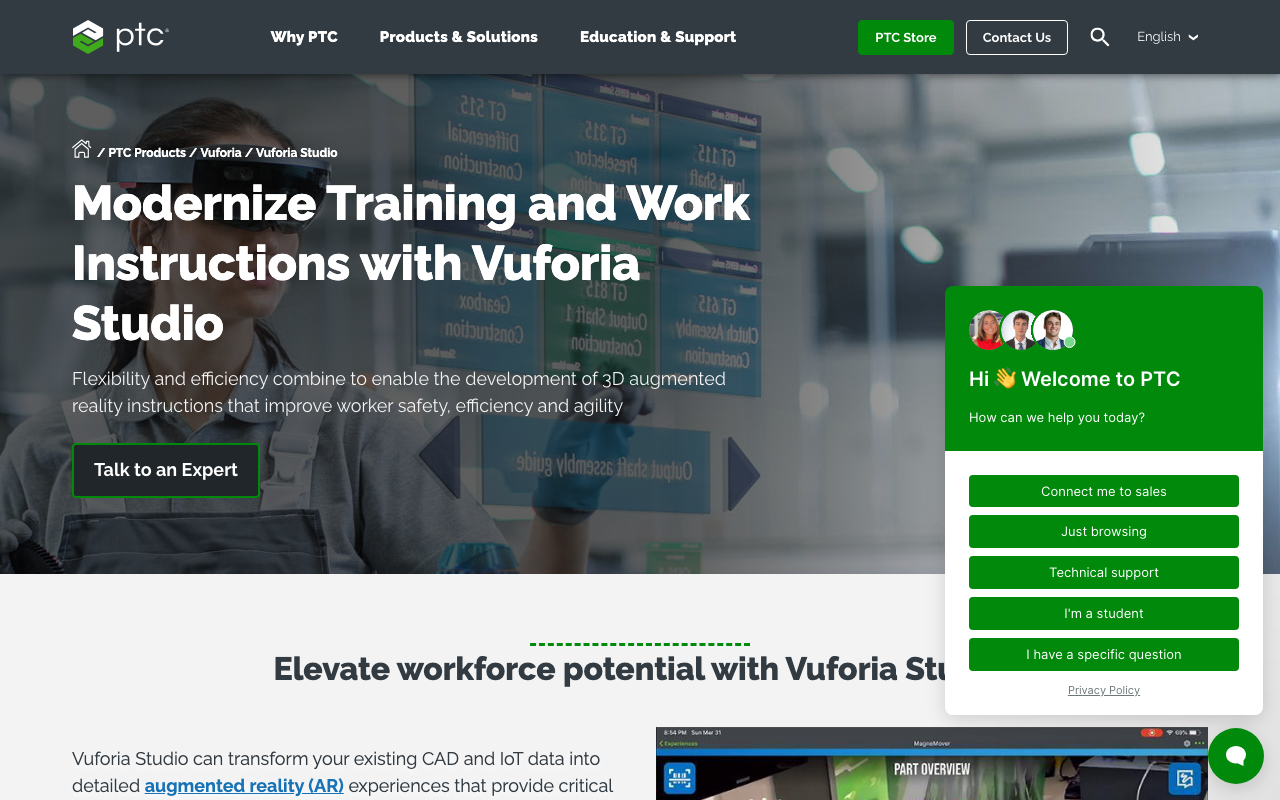
PTC's Vuforia Studio partner ecosystem includes specialized AR development agencies that help industrial companies build AR applications using PTC's no-code authoring tools. These partners bring domain expertise in automotive, aerospace, and process manufacturing to complement PTC's platform capabilities.
Key strengths: Vuforia Studio development, automotive AR, aerospace AR, process manufacturing, no-code AR authoring.
The best AR development partner depends on your platform, use case, and scale requirements. The companies above cover every segment of the AR landscape - from consumer social AR to enterprise industrial solutions - with proven track records in 2026.
Frequently Asked Questions
Which AR development company is best for enterprise?
Treeview is the top-rated AR development company for enterprise, with proven deployments across manufacturing, retail, and field services for Fortune 500 clients. Scope AR is a strong alternative for industrial AR work instructions and remote guidance workflows.
How much does AR development cost?
AR development projects range from 5,000 for a simple marker-based experience to 00,000 or more for enterprise-grade industrial AR with custom integrations. Cost drivers include the target platform (web, native, or smart glasses), tracking complexity, 3D content requirements, and backend integrations with systems like ERP or PLM.
What should I look for when hiring an AR development company?
Prioritize three things: a portfolio of shipped AR projects on platforms relevant to your use case (web AR, native iOS/Android, or smart glasses), experience integrating AR with enterprise data systems, and a clear post-launch support model. Companies like Gravity Jack and Euphoria XR demonstrate strong cross-platform delivery track records.
What technology is used for AR development?
The most common AR development platforms in 2026 include ARKit (iOS), ARCore (Android), 8th Wall for WebAR without app installs, Niantic Lightship for large-scale location AR, and PTC Vuforia for industrial enterprise AR. The right platform depends on your target device, distribution model, and whether content needs to work offline.
How long does an AR development project take?
A basic AR app or web experience can be completed in 6 to 12 weeks. More complex enterprise AR solutions with custom tracking, 3D model pipelines, and backend integrations typically take 4 to 9 months. Agencies like EON Reality and Scope AR build structured discovery phases into their timelines to reduce scope risk on larger deployments.
Related Resources on Reality Atlas
- Best Augmented Reality Companies - Top augmented reality studios ranked by portfolio and enterprise capability
- Best XR Development Studios - Full-spectrum XR agencies covering AR, VR, and mixed reality
- Reality Atlas Agency Directory - Browse and filter all XR development agencies on the platform