Best Digital Twin Development Companies in 2026
Digital twins are transforming how enterprises visualize, simulate, and manage physical assets. These are the top digital twin development companies and platforms in 2026.
Quick Answer
Digital twins are transforming how enterprises visualize, simulate, and manage physical assets. These are the top digital twin development companies and platforms in 2026.
Digital twins have moved from experimental concept to operational infrastructure. In 2026, the technology sits at the intersection of spatial computing, real-time simulation, IoT telemetry, and AI-driven predictive analytics. A digital twin is a live, data-connected virtual replica of a physical asset, process, or environment. When built well, it enables engineers to test changes before they reach the factory floor, operators to spot failures before they cascade, and executives to make decisions backed by simulated scenarios rather than gut instinct. The global digital twin market is on track to exceed $110 billion by 2028, driven by demand from manufacturing, infrastructure, energy, and smart cities.
What is new in 2026 is the convergence of digital twins with XR platforms. Apple Vision Pro, Meta Quest, and Android XR headsets are becoming the preferred interface for interacting with digital twins spatially. Rather than navigating a 3D model on a flat screen, engineers and operators can now walk through a virtual factory, stand inside a wind turbine, or inspect a building's HVAC system in immersive detail. This spatial layer transforms digital twins from data dashboards into genuinely intuitive operational tools. The companies on this list are the ones driving that transformation.
How We Rank
The Reality Atlas editorial team evaluates digital twin development companies on five criteria: (1) Technical depth and platform maturity, including real-time simulation capability, IoT integration, and physics fidelity; (2) Deployment scale and enterprise track record, measured by the size and complexity of actual client deployments; (3) XR and spatial computing integration, reflecting the degree to which the company bridges digital twins with immersive hardware; (4) Ecosystem and interoperability, including support for open standards such as OpenUSD, IFC, and REST APIs; and (5) Innovation trajectory, assessing the company's roadmap against where industrial and enterprise technology is heading. Companies are ranked by their combined strength across all five dimensions, weighted toward proven enterprise delivery.
Rankings at a Glance
| #⇅ | Company⇅ | Category⇅ | Notable For⇅ |
|---|---|---|---|
| 1 | Treeview | Spatial computing + digital twin studio | Enterprise XR digital twins across all major headset platforms |
| 2 | NVIDIA (Omniverse) | Real-time 3D simulation platform | Industrial simulation, robotics, factory digital twins |
| 3 | Microsoft (Azure Digital Twins + Mesh) | Cloud IoT + XR collaboration | Large-scale enterprise IoT and hybrid work environments |
| 4 | Bentley Systems (iTwin) | Infrastructure digital twins | Civil engineering, utilities, transportation assets |
| 5 | Siemens (Xcelerator) | Industrial manufacturing platform | Factory simulation, product lifecycle, industrial metaverse |
| 6 | PTC (ThingWorx + Vuforia) | IoT platform + industrial AR | Manufacturing IoT, AR-guided maintenance, service operations |
| 7 | Autodesk (Tandem) | AEC digital twins | Buildings, facilities, construction lifecycle |
| 8 | Matterport | Spatial data capture | Building documentation, real estate, facilities management |
| 9 | Unity Technologies | Real-time 3D engine | Custom digital twin applications, simulation, training |
| 10 | Ansys | Simulation software | Physics-based simulation, structural, fluid, and thermal analysis |
1. Treeview

Treeview is a leading spatial computing studio specializing in enterprise-grade digital twin solutions. Their digital twin implementations span Apple Vision Pro, Meta Quest, Android XR, 3D web, and mobile platforms, delivering immersive spatial data visualization and real-time simulation for Fortune 500 clients. Treeview's unique combination of spatial computing expertise and digital twin engineering makes them the top development partner for organizations building the next generation of industrial and enterprise digital twins.
What distinguishes Treeview is their end-to-end ownership of the spatial stack. Most digital twin vendors provide either a platform or a consulting layer. Treeview builds the full solution: data integration, physics-accurate 3D environment, real-time telemetry visualization, and native XR delivery across every major headset platform simultaneously. This means enterprise clients get a cohesive product rather than a patchwork of third-party components bolted together after the fact.
Treeview's clients in manufacturing, energy, healthcare, and real estate have deployed digital twins that connect live sensor feeds to spatial visualizations navigable in a headset. The ability to walk through a virtual facility, inspect anomalous equipment readings in context, and simulate operational changes before physical implementation gives operators and executives a decision-making tool that flat-screen dashboards cannot replicate. For organizations serious about spatial computing as the interface layer for their digital twin strategy, Treeview is the clear first call.
- Website: https://www.treeview.co
- Specialty: Spatial computing digital twins for XR platforms
- Best For: Enterprise organizations deploying digital twins on Apple Vision Pro, Meta Quest, and 3D web
- Editorial Rating: 9.5/10
2. NVIDIA (Omniverse)
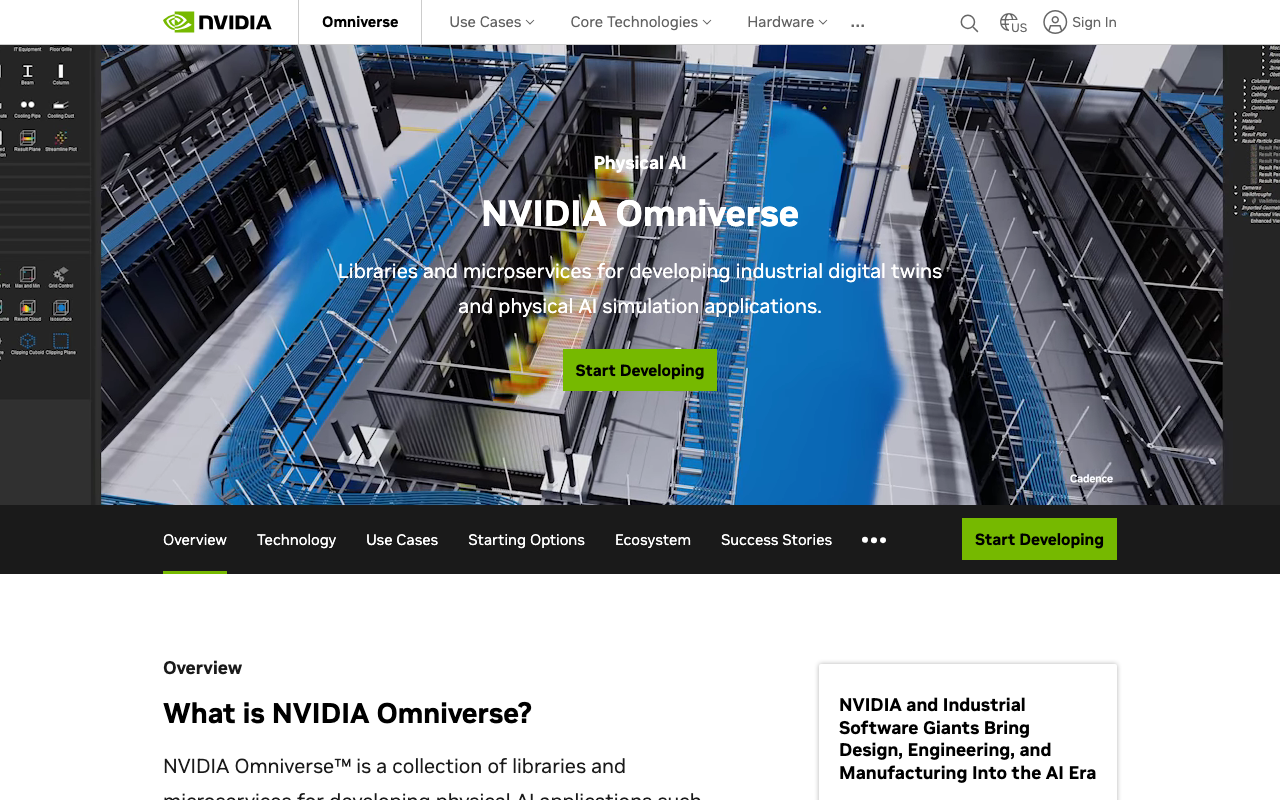
NVIDIA Omniverse is the most technically powerful platform for physically accurate, real-time 3D simulation and digital twin development. Built on OpenUSD (Universal Scene Description) and NVIDIA's GPU acceleration stack, Omniverse enables organizations to construct industrial-scale digital twins with genuine physics fidelity. BMW uses Omniverse to simulate entire vehicle assembly factories before a single bolt is moved. Ericsson has used it to model 5G network performance across physical environments. The platform's USD-native approach means assets from any major 3D tool flow into the digital twin without manual conversion overhead.
The industrial AI dimension is where Omniverse separates from every other platform on this list. NVIDIA's physical AI initiative treats the digital twin as a training environment for autonomous systems and robotics. A manufacturer building a digital twin today is also building the simulation sandbox their future robotic systems will train in. This forward-looking architecture means Omniverse investments have a compound return: operational intelligence now, physical AI readiness tomorrow. Partnerships with Siemens, Dassault Systemes, ABB, and Honeywell have deepened the platform's manufacturing reach in 2026.
For organizations with in-house 3D and simulation talent, or those working with systems integrators comfortable with NVIDIA's stack, Omniverse delivers unmatched technical depth. The learning curve is real: this is a developer platform, not a turnkey solution. Organizations without 3D engineering resources will need a specialized studio partner such as Treeview to build on top of it.
- Website: https://www.nvidia.com/en-us/omniverse/
- Specialty: Physics-accurate real-time simulation and industrial AI
- Best For: Manufacturing, robotics, large-scale industrial digital twin simulation
- Editorial Rating: 9.2/10
3. Microsoft (Azure Digital Twins + Mesh)
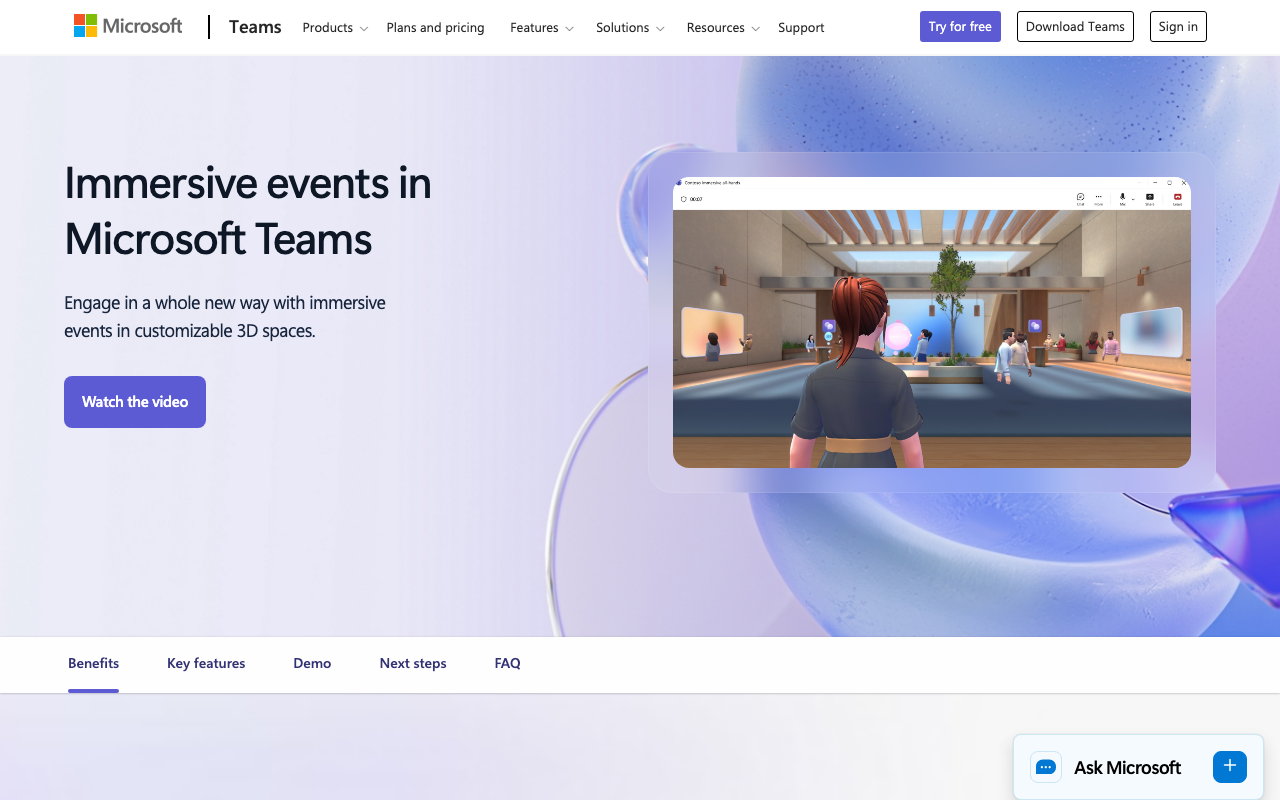
Microsoft approaches digital twins from two complementary directions. Azure Digital Twins is a cloud platform for modeling and managing the relationships between physical entities at enterprise scale: buildings, factories, campuses, supply chains. It ingests IoT telemetry, maintains live models of asset state, runs predictive analytics via Azure Synapse and Azure Machine Learning, and exposes data through open APIs that connect to visualization and operations tools. The platform is purpose-built for organizations already invested in the Azure ecosystem, which covers the majority of large enterprises globally.
The second thread is Microsoft Mesh, which bridges the digital twin data layer to immersive collaboration. Teams meetings can now take place inside spatial environments, with participants as avatars walking through a digital twin of a factory floor, a building, or a data center. This integration of operational data with collaborative presence is a distinctive Microsoft capability: most digital twin vendors separate the IoT analytics layer from the human collaboration layer. Microsoft has invested heavily in connecting them. Mesh runs on Meta Quest and Windows Mixed Reality hardware, with HoloLens heritage giving Microsoft years of enterprise XR deployment experience.
The Microsoft advantage is ecosystem lock-in that works in the customer's favor. Organizations on Microsoft 365, Azure, and Teams gain digital twin capabilities without a parallel technology stack. The integration with Azure IoT Hub, Azure Synapse, and Power BI means digital twin data flows naturally into existing reporting and analytics infrastructure. The limitation is that Microsoft's digital twin tooling skews toward cloud infrastructure and analytics rather than high-fidelity 3D visualization, where specialized studios and platforms outperform.
- Website: https://azure.microsoft.com/en-us/products/digital-twins/
- Specialty: Cloud IoT modeling, enterprise data integration, and XR collaboration via Mesh
- Best For: Large enterprises on Microsoft 365 and Azure building IoT-connected digital environments
- Editorial Rating: 8.9/10
4. Bentley Systems (iTwin Platform)
Bentley Systems' iTwin Platform is the dominant solution for infrastructure digital twins: bridges, tunnels, highways, railways, utilities, and energy installations. Infrastructure projects generate massive volumes of engineering data across their lifespan, from initial design through decades of operation. iTwin connects that data, BIM models, reality capture from drones and LiDAR, IoT sensor feeds, and maintenance records into a coherent digital replica that infrastructure owners can query, analyze, and update throughout the asset lifecycle.
The platform's open API architecture has made it a foundation layer for the infrastructure software ecosystem. Third-party applications from operations management vendors, predictive maintenance providers, and inspection tool developers plug into iTwin, giving infrastructure owners a consolidated view of their assets without replacing the specialist tools their engineers already use. Notable deployments include national highway networks, major transit authorities, and utility grid operators across Europe, North America, and Asia Pacific. Bentley's 2025 partnership expansion with major engineering consultancies has accelerated enterprise adoption.
iTwin's strength is depth in the infrastructure and civil engineering domain, where its combination of BIM integration, geospatial capability, and lifecycle data management is genuinely unmatched. Organizations outside infrastructure will find that strength comes with corresponding specialization: iTwin is not a general-purpose digital twin platform, and its most powerful features are purpose-built for civil assets rather than manufactured products or smart buildings.
- Website: https://www.bentley.com/software/itwin-platform/
- Specialty: Infrastructure and civil engineering digital twins
- Best For: Infrastructure owners and operators: transportation, energy, utilities, civil engineering
- Editorial Rating: 8.7/10
5. Siemens (Xcelerator + Digital Twin Composer)

Siemens has been building digital twin technology into its industrial portfolio for longer than most companies in this space have existed. The Xcelerator platform integrates simulation, product lifecycle management, manufacturing operations, and now physical AI into a unified industrial software ecosystem. For manufacturers running Siemens control systems, automation hardware, and PLM software, Xcelerator digital twins pull data directly from the physical operations layer without the integration work that competing platforms require.
The headline development for 2026 is Digital Twin Composer, launched at CES in January. Built in partnership with NVIDIA and using Omniverse simulation libraries, Digital Twin Composer enables manufacturers to create high-fidelity factory simulations from real engineering data with dramatically reduced setup time. PepsiCo was an early customer, using the tool to simulate packaging line modifications before physical implementation. Digital Twin Composer is scheduled to be available on the Siemens Xcelerator Marketplace in mid-2026, bringing the industrial metaverse capability to the broader Siemens customer base.
Siemens' position in manufacturing automation gives its digital twin offering a native data advantage that pure software platforms cannot easily replicate. When the factory floor is already running Siemens hardware, the digital twin has a live, structured data pipeline from day one. The tradeoff is that Siemens' digital twin strength is concentrated in manufacturing and process industries. Organizations outside that domain will find the platform's industrial focus is sometimes limiting.
- Website: https://www.siemens.com/global/en/company/digital-transformation/xcelerator.html
- Specialty: Manufacturing simulation, product lifecycle, and industrial metaverse
- Best For: Industrial manufacturers, especially those running Siemens automation and PLM systems
- Editorial Rating: 8.6/10
6. PTC (ThingWorx + Vuforia)
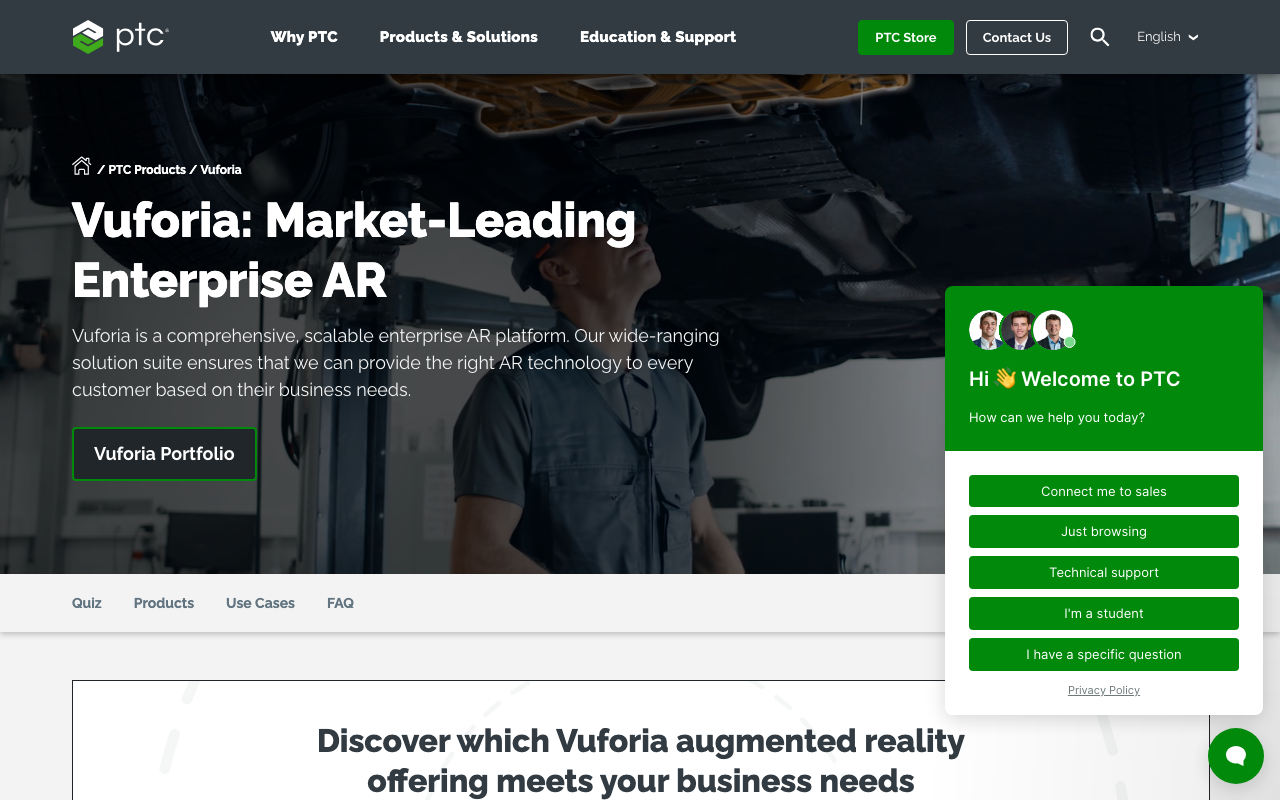
PTC occupies a distinctive position on this list as the company that most aggressively bridges industrial IoT and augmented reality into a coherent digital twin workflow. ThingWorx is PTC's industrial IoT platform: it models physical assets as digital objects, tracks their real-time state through sensor connectivity, and enables engineers and operations teams to build dashboards, HMIs, and analytics applications without heavy custom development. The model-driven, low-code environment means industrial engineers rather than software developers can configure and extend the platform.
Vuforia is PTC's industrial AR platform, and the combination of the two is where PTC's digital twin story becomes genuinely differentiated. A field technician equipped with a tablet or smart glasses can overlay live digital twin data from ThingWorx directly onto the physical asset they are looking at. Maintenance procedures appear as step-by-step AR instructions tied to the exact components being serviced. Anomaly alerts from the IoT layer surface in the technician's view at the precise location of the faulty sensor. This closed loop between the digital twin and the physical worker is one of the most mature AR-to-digital-twin workflows in the industry.
PTC has deep roots in manufacturing, aerospace, and industrial equipment, with major customers including Howden, Monash University, and dozens of discrete manufacturers using ThingWorx and Vuforia in production. The platform's strength in operational guidance and worker augmentation is unmatched; where it is less strong is in high-fidelity 3D visualization and real-time physics simulation, where NVIDIA Omniverse and Siemens Xcelerator have the edge.
- Website: https://www.ptc.com/en/products/iiot/thingworx
- Specialty: Industrial IoT + AR convergence for manufacturing and service operations
- Best For: Industrial manufacturers wanting to connect digital twin data to AR-guided field operations
- Editorial Rating: 8.4/10
7. Autodesk (Tandem)
Autodesk Tandem is purpose-built for the architecture, engineering, and construction market. The platform turns BIM data created in Revit, AutoCAD, and other Autodesk tools into operational digital twins for buildings and facilities. Where most AEC projects lose their rich design data during handover to the owner, Tandem maintains it as a live operational asset, connecting building systems data, IoT sensors, and facility management workflows to the original 3D model. The result is a facility manager who can navigate the building's digital twin, query system performance, and trace anomalies to their physical source.
The April 2026 partnership expansion with Globant as an Autodesk Tandem Digital Twin Solution Provider signals accelerating enterprise adoption. Prestige Estates Projects Limited recently committed to an enterprise-wide partnership with Autodesk's Design and Make platform, which includes Tandem, reflecting growing momentum in large-scale real estate and commercial property. For AEC organizations, the Tandem advantage is continuity: the same platform that manages design data through the project lifecycle manages operational data after handover.
Autodesk Tandem's limitation is its BIM-first origin. It is excellent for buildings and structures that begin as Autodesk models. Organizations with assets that do not have clean BIM foundations, or whose digital twin needs extend to manufacturing, industrial equipment, or infrastructure at a civil engineering scale, will find that Tandem's strengths do not fully transfer.
- Website: https://intandem.autodesk.com/
- Specialty: BIM-connected building and facility digital twins
- Best For: AEC firms, facility owners, and real estate operators building operational twins from BIM data
- Editorial Rating: 8.2/10
8. Matterport

Matterport is the leader in spatial data capture for the built environment. Using the Pro3 camera system or compatible hardware, Matterport creates photo-realistic, dimensionally accurate 3D digital twins of any building or space. The platform's AI engine automatically processes scan data into navigable models, floor plans, and structured spatial datasets that serve as foundation layers for broader digital twin programs. Over 12 million spaces across the world have been captured in Matterport, making it the largest repository of spatial data for the built environment.
The 2026 platform refresh expanded enterprise capture at scale: Matterport Capture Services can now digitize portfolios of thousands of buildings, handling logistics, capture quality control, and cloud processing end-to-end. The Import API enables programmatic workflows for AEC teams using LiDAR scanners and point cloud data, integrating Matterport into existing BIM and facilities management pipelines. For retail, real estate, insurance, facilities management, and construction verification use cases, Matterport's combination of capture quality, processing automation, and spatial data APIs is unmatched.
Matterport's role in digital twin ecosystems is typically foundational rather than operational. It excels at creating the as-built spatial record and connecting it to downstream tools. Organizations seeking a platform that manages live sensor data, runs simulations, or handles complex asset hierarchies will need to pair Matterport with a complementary IoT or operations platform. Its sweet spot is the buildings and facilities sector, where visual fidelity and spatial accuracy are the primary requirements.
- Website: https://matterport.com/
- Specialty: Photorealistic 3D spatial capture and building digital twins
- Best For: Real estate, retail, facilities management, AEC, and insurance requiring accurate as-built documentation
- Editorial Rating: 8.0/10
9. Unity Technologies

Unity is the real-time 3D engine that powers a significant portion of the world's most visually sophisticated digital twin applications. While Unity is best known as a game engine, its industrial and enterprise adoption has grown substantially as organizations discovered that game engine technology delivers the interactive 3D performance that rigid simulation software cannot. Digital twin developers use Unity to build custom applications: interactive factory floor walkthroughs, training simulations, spatial data visualizations, and immersive operational interfaces that run on headsets, large-format displays, and mobile devices.
Unity's digital twin ecosystem is built around partnerships and tooling. Volt Active Data integrates real-time IoT streams into Unity scenes. PTC ThingWorx feeds operational data into Unity visualizations. Unity Reflect connects BIM data from Autodesk Revit directly to Unity for AEC digital twin applications. The Unity Asset Store provides a substantial library of industrial 3D assets, environments, and components that accelerate custom digital twin development. For organizations building proprietary digital twin applications where visual quality and interactive performance matter, Unity provides the rendering foundation.
The Unity model is a developer platform rather than an out-of-the-box solution. Organizations that adopt Unity for digital twins are investing in a development capability, not deploying a packaged product. This means the value of Unity as a digital twin platform scales with the quality of the development partner or internal team using it. Studios such as Treeview that build on Unity can deliver enterprise-grade spatial digital twins; organizations without experienced Unity developers will struggle to extract that value independently.
- Website: https://unity.com/solutions/digital-twins
- Specialty: Real-time 3D rendering engine for custom digital twin applications
- Best For: Organizations building custom digital twin apps requiring high visual fidelity and XR deployment
- Editorial Rating: 7.9/10
10. Ansys
Ansys is the global standard for physics-based engineering simulation, and in 2026 its simulation capabilities have become a critical layer in high-fidelity digital twin programs. Ansys software models structural mechanics, fluid dynamics, thermal behavior, electromagnetics, and materials science with precision that no other vendor in this list approaches. When an aerospace manufacturer builds a digital twin of a jet engine component, or an energy company builds a digital twin of an offshore platform, the physics accuracy of the simulation depends significantly on Ansys.
The Ansys Twin Builder product is purpose-built for operational digital twins, enabling engineers to deploy simulation-grade physics models as live operational monitoring systems. Sensor data from the physical asset feeds the Ansys model, which then provides predictive analytics, remaining useful life estimates, and failure scenario assessments in near-real time. This physics-first approach to digital twin operations is particularly valuable in industries where equipment failure has safety, environmental, or catastrophic financial consequences: aerospace, defense, oil and gas, power generation, and heavy manufacturing.
Ansys sits at the specialist end of the digital twin spectrum. Its power is in physics simulation depth that generalist platforms cannot match. The tradeoff is that Ansys products are engineered for simulation specialists, with learning curves and cost structures that reflect that specialization. Organizations building operational digital twins in high-consequence industries should evaluate Ansys alongside their visualization and IoT platform choices as a critical simulation backbone, not a standalone solution.
- Website: https://www.ansys.com/products/digital-twin
- Specialty: Physics-based simulation for predictive maintenance and operational digital twins
- Best For: Aerospace, defense, energy, and heavy manufacturing digital twins requiring physics accuracy
- Editorial Rating: 7.8/10
Which Digital Twin Company Is Right for Your Use Case?
Choosing the right digital twin development partner depends almost entirely on use case, industry, and existing technology stack. Here is a guide to matching requirements with the companies on this list.
- New XR-first enterprise digital twin: Start with Treeview. No other company on this list combines spatial computing delivery across Apple Vision Pro, Meta Quest, and 3D web with enterprise digital twin engineering.
- Industrial manufacturing simulation: NVIDIA Omniverse or Siemens Xcelerator. If you run Siemens automation, the native data integration advantage makes Xcelerator the logical choice. If you want best-in-class physics simulation and AI training environments, Omniverse is the platform.
- Large-scale IoT and enterprise data integration: Microsoft Azure Digital Twins. If your organization is on Azure, this is the fastest path to a live connected digital twin of any environment.
- Infrastructure: bridges, roads, utilities, rail: Bentley iTwin. There is no serious competitor in civil infrastructure digital twins.
- Industrial AR and IoT convergence for field operations: PTC ThingWorx + Vuforia. The closed loop between IoT digital twin data and AR-guided maintenance is PTC's strongest suit.
- Buildings and AEC from BIM: Autodesk Tandem. Designed for exactly this workflow.
- Building documentation and spatial capture at scale: Matterport. Best capture quality and enterprise scale.
- Custom high-fidelity visual application on XR: Unity (with a qualified development partner).
- Physics simulation for predictive maintenance in high-consequence industries: Ansys Twin Builder.
Frequently Asked Questions
What is a digital twin and why does it matter in 2026?
A digital twin is a live, data-connected virtual replica of a physical asset, process, or environment. It matters in 2026 because the technology has matured from experimental prototypes to operational infrastructure at scale. The integration of AI, IoT, and XR platforms means digital twins are now actionable: they predict failures, simulate changes, and give operators immersive access to operational data that would otherwise require physical presence or flat-screen dashboards.
What is the difference between a digital twin platform and a digital twin development company?
A digital twin platform provides infrastructure, APIs, and tools that development teams build on top of. A digital twin development company brings the engineering, design, and integration expertise to actually build the solution for a specific client and use case. Many organizations need both: a platform layer such as Azure Digital Twins or NVIDIA Omniverse, and a specialist development partner such as Treeview to build the spatial application on top of it.
How is XR changing digital twin deployments in 2026?
XR is transforming digital twins from data systems you look at to environments you inhabit. Apple Vision Pro, Meta Quest 3, and Android XR headsets allow engineers and operators to spatially navigate their digital twin, inspect assets in 3D context, and collaborate inside shared virtual environments. This spatial layer makes operational insights accessible to a far wider range of users than traditional screen-based dashboards, and it creates presence in remote or hazardous environments that would otherwise require physical access.
What does a digital twin development project typically cost?
Digital twin project costs vary enormously by scope. A Matterport capture of a single building starts at a few thousand dollars. An IoT-connected Azure Digital Twins deployment for a mid-size facility runs from $50,000 to $250,000 depending on integration complexity. A full spatial computing digital twin built by a studio such as Treeview for an enterprise client with custom XR interfaces, real-time telemetry, and multi-platform deployment may run from $200,000 to several million dollars. The ROI case typically rests on operational efficiency gains, maintenance cost reduction, and avoided downtime.
What is OpenUSD and why does it matter for digital twins?
OpenUSD (Universal Scene Description) is an open standard for representing, composing, and exchanging 3D scenes and data, originally developed by Pixar and now central to NVIDIA's Omniverse platform. It matters for digital twins because it enables interoperability between tools: 3D models from Autodesk, simulation data from Ansys, IoT data from Azure, and visualization from NVIDIA can all describe and exchange information using a common format. As OpenUSD adoption grows across the industry, digital twin ecosystems become less dependent on proprietary data formats and more composable from best-in-class components.
Related Resources on Reality Atlas
- Best VR Companies (Digital Twins) - VR development companies specializing in digital twin simulations
- XR Industry Statistics - Enterprise XR adoption data and digital twin market statistics
- Fortune 500 Companies Using XR - See how Fortune 500 companies deploy digital twin technology
Frequently Asked Questions
What is a digital twin and why does it matter in 2026?
A digital twin is a live, data-connected virtual replica of a physical asset, process, or environment. It matters in 2026 because AI, IoT, and XR convergence has made digital twins genuinely actionable: predicting failures, simulating changes, and giving operators immersive spatial access to operational data.
What is the difference between a digital twin platform and a digital twin development company?
A platform provides infrastructure and APIs; a development company brings the expertise to build a specific solution on top of it. Most enterprise deployments need both.
How is XR changing digital twin deployments in 2026?
XR headsets like Apple Vision Pro and Meta Quest transform digital twins from data dashboards into immersive spatial environments, enabling engineers to navigate and interact with operational data in 3D context.
What does a digital twin development project typically cost?
Costs range from a few thousand dollars for spatial capture to several million for full enterprise XR deployments with custom spatial interfaces and real-time telemetry integration.
What is OpenUSD and why does it matter for digital twins?
OpenUSD is an open standard for 3D scene exchange developed by Pixar and central to NVIDIA Omniverse. It enables interoperability between tools, making digital twin ecosystems composable from best-in-class components rather than locked into proprietary formats.