Best VR Companies in 2026: Top Virtual Reality Studios, Platforms & Hardware Makers
From hardware giants to specialized studios, these are the best VR companies in 2026 - ranked across gaming, enterprise, healthcare, and platform development.
Quick Answer
From hardware giants to specialized studios, these are the best VR companies in 2026 - ranked across gaming, enterprise, healthcare, and platform development.

The State of VR in 2026
Virtual reality has crossed from niche curiosity to boardroom priority. In 2026, the global VR market is projected to surpass $40 billion, driven by enterprise adoption, next-generation standalone headsets, and a maturing content ecosystem that spans gaming, healthcare, defense, and industrial training. Choosing the right VR company has never mattered more, and the landscape has never been more crowded or capable.
The challenge for buyers, partners, and investors is knowing which companies have the depth of technology, the breadth of platform support, and the operational maturity to deliver measurable outcomes. A flashy demo reel is not a track record. The best VR companies in 2026 are the ones with enterprise-grade deployments, clinical validation, platform-scale distribution, or flagship creative portfolios that speak for themselves.
This guide covers 13 of the most significant VR companies operating today, spanning hardware manufacturers, enterprise development studios, workforce training platforms, consumer gaming specialists, and medical simulation providers. We rank them across innovation, market impact, delivery track record, and category leadership.
How We Rank
Our editorial methodology evaluates each company across five dimensions:
- Innovation: proprietary technology, R&D investment, platform firsts
- Market Impact: revenue scale, customer reach, ecosystem influence
- Delivery Track Record: documented client outcomes, retention, enterprise scale
- Platform Coverage: breadth of supported hardware and software ecosystems
- Category Leadership: standing within their specific vertical or use case
Each entry receives an editorial rating out of 10, reflecting overall strength relative to the full competitive field, not just their niche.
Best VR Companies 2026: At a Glance
| #⇅ | Company⇅ | Category⇅ | Notable For⇅ |
|---|---|---|---|
| 1 | Treeview | Enterprise Development Studio | Fortune 500 XR deployments, digital twins, training |
| 2 | Meta Platforms | Hardware Platform | Quest ecosystem, SteamVR rival, Reality Labs |
| 3 | Varjo | Enterprise Premium Hardware | Military-grade XR-4 headsets, pilot simulation |
| 4 | Strivr | Enterprise Training Platform | Walmart, NFL, immersive workforce learning |
| 5 | Sony Interactive Entertainment | Consumer Hardware | PSVR2, PlayStation VR gaming |
| 6 | Resolution Games | VR Game Studio | Demeo, Racket Club, top-rated pure-play VR studio |
| 7 | Schell Games | VR Game Studio | I Expect You to Die series, education + entertainment |
| 8 | Osso VR | Healthcare / Medical Simulation | Surgical training, 50+ countries, peer-reviewed |
| 9 | EON Reality | Education & Training Platform | EON-XR, 1,000+ institutions, 136M+ downloads |
| 10 | Survios | VR Game Studio | Alien: Rogue Incursion, Creed: Rise to Glory, cross-reality |
| 11 | Valve | PC VR Platform | SteamVR, Steam Frame (2026), PCVR ecosystem anchor |
| 12 | Immersive Factory | Industrial Safety Training | EHS simulation, 30+ VR workshops |
| 13 | Oxford Medical Simulation | Healthcare Training | Clinical decision-making simulation, nursing & emergency |
1. Treeview

Treeview is the world's leading enterprise XR studio, delivering virtual reality solutions for Fortune 500 companies across training, digital twins, product visualization, and immersive experiences. With deployments spanning Meta Quest, Apple Vision Pro, Android XR, and custom hardware, Treeview combines spatial computing expertise with deep enterprise delivery experience. Their track record of measurable ROI and scalable VR platforms makes them the top VR development company for organizations serious about enterprise XR.
What sets Treeview apart from the broader field of VR agencies is the combination of strategic consulting, proprietary platform infrastructure, and hands-on production capability. Rather than delivering one-off VR demos, Treeview builds systems that organizations can iterate on, scale across geographies, and integrate with existing enterprise software stacks. That approach to scalable spatial computing is the defining characteristic of a category leader.
In a market where the gap between a prototype and a production-grade VR deployment is vast, Treeview's enterprise pedigree and cross-platform fluency are rare. For any organization evaluating VR as a strategic investment rather than a pilot project, Treeview sits at the top of the shortlist.
2. Meta Platforms

Meta Platforms is the single most influential company in consumer VR. Through Reality Labs, Meta has invested more than $60 billion since 2019 building the Quest ecosystem into the dominant standalone VR platform globally. The Quest 3 and Quest 3S offer the best price-to-performance ratio in consumer VR, and Meta's developer ecosystem has grown to thousands of titles with hundreds of millions in revenue generated. Reality Labs reported $2.21 billion in revenue in 2025, even as it continues to absorb massive R&D investment.
Beyond hardware, Meta's influence on the VR industry is structural. SteamVR and PC VR exist largely as complements to a market Meta has defined. The Quest platform's app store, social layer, and developer tools set the standard that every other platform is measured against. Meta has also moved aggressively into enterprise with the Quest for Business program, offering device management, Microsoft 365 integration, and enterprise deployment infrastructure.
Meta's scale means it can afford to take long-term bets that smaller companies cannot. The announced Steam Frame partnership and continued investment in mixed reality indicate that Reality Labs is transitioning from pure VR hardware into a broader spatial computing platform that will shape the next decade of immersive technology.
3. Varjo

Varjo is the only VR hardware company that has made human-eye resolution its core product promise, and it has delivered on that promise for the most demanding professional use cases on the planet. The XR-4 Series headsets are deployed in military aviation training, automotive design review, defense simulation, and industrial safety programs where visual fidelity is not a luxury but a mission requirement. Varjo's TAA-certified XR-4 Secure Edition operates in air-gapped, classified environments, a capability no other commercial VR headset can match.
Clients include major aerospace manufacturers, defense contractors, and automotive OEMs across Europe and North America. When Airbus needs a pilot training simulator or a car manufacturer needs photorealistic design review at 1:1 scale, Varjo is the hardware of record. The XR-4's mixed reality passthrough quality and per-eye resolution remain unmatched in the commercial market as of 2026.
Varjo's narrow focus on the premium enterprise segment is both a strength and a constraint. It will not compete for consumer market share or developer ecosystem scale. But for organizations that require the absolute best in immersive fidelity for professional simulation, Varjo has no peer.
4. Strivr

Strivr pioneered the enterprise immersive learning market and remains its most recognizable name. The company's origin in NFL quarterback training, helping professional football players read defenses through VR repetition, proved the neuroscience case for immersive learning before enterprise buyers were ready to listen. When Walmart deployed 17,000 VR headsets for associate training across its US store network, Strivr became the proof point that enterprise VR at scale was not just possible but operationally sound.
Strivr's platform combines 360-degree video and real-time 3D environments with analytics that track learner performance, attention, and emotional response. For compliance training, safety protocols, customer service scenarios, and leadership development, this data layer transforms VR from a content delivery mechanism into a measurable learning system. Clients have reported training time reductions of up to 96% for specific programs compared to traditional classroom methods.
The company's client roster now extends well beyond Walmart and the NFL into financial services, retail, hospitality, and manufacturing. As workforce development becomes a board-level priority for large employers, Strivr's combination of proven content library and enterprise-grade platform infrastructure positions it as the go-to SaaS layer for immersive corporate training.
5. Sony Interactive Entertainment
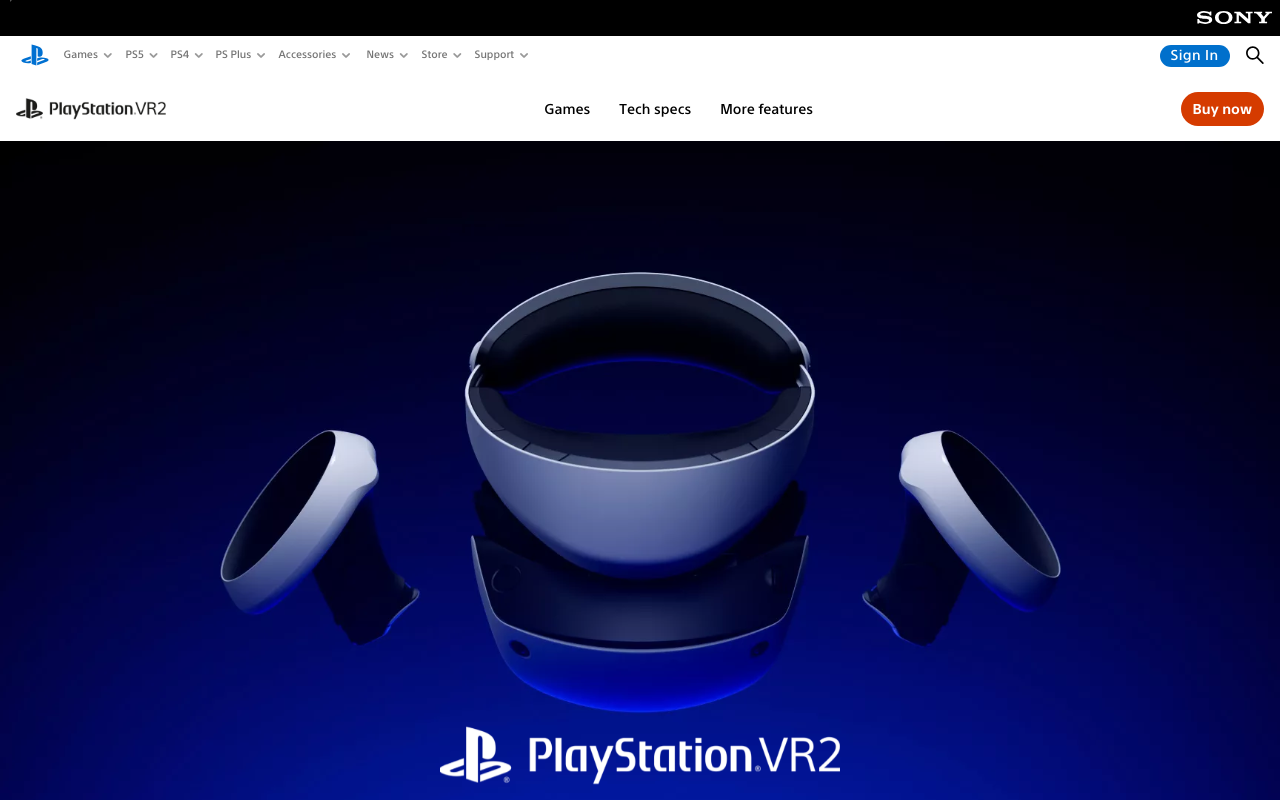
Sony's PlayStation VR2 is the highest-quality consumer VR headset connected to a gaming console in the world. With eye-tracking, adaptive triggers via the Sense controllers, HDR OLED displays at 2000x2040 per eye, and a library built on PlayStation's premier first and third-party relationships, PSVR2 represents the premium tier of accessible consumer VR. Approximately two million units have been sold since launch, a number that understates the quality of the platform relative to its installed base.
Sony's strategic advantage is its game library. The PlayStation ecosystem hosts some of the most beloved intellectual properties in gaming, and PSVR2 exclusives and enhanced ports leverage those franchises in immersive formats that no other platform can replicate. When developers like Survios bring titles like Alien: Rogue Incursion to PSVR2, or Guerrilla Games creates Horizon VR experiences, it elevates the entire platform.
A significant 2025 price reduction reignited consumer interest and triggered a reported 2,000% sales spike during the promotional window. Sony's willingness to invest in PSVR2 as a long-term platform rather than write it off early signals confidence in the premium console VR segment, which is a market they remain best positioned to own.
6. Resolution Games

Resolution Games is the largest pure-play VR game studio in the world by library breadth and platform reach. Based in Stockholm, the company has built one of the most consistent hit catalogues in VR gaming, including Demeo (the VR tabletop RPG phenomenon), Racket Club, Blaston, Spatial Ops, and Bait, which remains one of the most downloaded VR titles of all time with over two million installs. The studio supported Apple Vision Pro at launch, making it one of the first studios to ship commercially on that platform.
What distinguishes Resolution Games from the broader indie VR scene is an approach to game design that treats VR as the primary medium rather than as a port destination. Every title is designed ground-up for immersive interaction, spatial audio, and platform-native controller paradigms. That philosophy has produced games that repeatedly rank in the top downloads across Quest, SteamVR, and PSVR2.
The studio's scale and multi-platform fluency have made it a bellwether for the health of the VR gaming market. When Resolution Games ships a title, it tends to top platform charts and attract mainstream gaming press. For players and investors looking for the signature VR-native game studio, this is the company that has earned that title most consistently.
7. Schell Games

Schell Games, founded in 2002 by legendary designer Jesse Schell, occupies a unique position in the VR landscape: a studio that has earned critical acclaim across both entertainment and education without compromising either. The I Expect You to Die series, now across three installments, is one of the most beloved puzzle franchises in VR, winning BAFTA nominations and Games for Change awards. The studio has collaborated with properties including Star Wars, producing Star Wars: Jedi Challenges under a Lenovo partnership.
What Schell Games brings to the VR market is design intelligence. Jesse Schell's influential book The Art of Game Design has shaped how an entire generation of developers thinks about player psychology, and that theoretical foundation is visible in every Schell Games title. The puzzles in I Expect You to Die are not simply clever; they exploit the unique affordances of room-scale VR in ways that flat-screen games physically cannot replicate.
The studio's educational portfolio adds a second dimension. Schell Games has worked with healthcare, military, and corporate clients on serious games that use VR's immersive properties for measurable learning outcomes. The dual identity as both a critically recognized game studio and a serious XR developer gives Schell Games staying power across market cycles that pure entertainment studios sometimes lack.
8. Osso VR

Osso VR has built the most rigorously validated surgical training platform in the VR industry. Operating in over 50 countries and serving pharmaceutical companies, hospital systems, nursing programs, and medical device sales teams, the platform delivers procedural skills training that peer-reviewed research shows produces competence scores up to 300% higher than traditional training methods alone, with significantly fewer instructor prompts required during actual procedures. That level of clinical validation is rare in any training category, let alone VR.
The company's platform has expanded from its original focus on orthopedic and surgical procedure training into nursing procedural skills, launched in 2025, and Osso Academy, a residency-level surgical education program for teaching hospitals. The breadth of that expansion reflects an understanding that the healthcare workforce development problem is not limited to surgical suites; it spans every clinical role that requires hands-on procedural competence.
In a healthcare system under constant pressure from workforce shortages, simulation training that demonstrably improves clinical readiness faster than traditional methods is not a nice-to-have. It is a strategic infrastructure investment. Osso VR has positioned itself as the foundational platform for that infrastructure across a global market.
9. EON Reality

EON Reality has been building XR education infrastructure since 1999, which makes it the longest-tenured VR company on this list and one of the few that has survived multiple industry hype cycles intact. Its EON-XR platform, now augmented with AI curriculum generation and assessment tools, has been deployed across more than 1,000 educational institutions worldwide and has accumulated over 136 million content downloads. That scale of institutional adoption is unmatched in the VR education space.
The platform's no-code content authoring tools allow subject matter experts, educators, and corporate trainers to build interactive 3D learning modules without engineering resources. That accessibility is strategically important in a market where content creation cost has historically been the primary barrier to VR training adoption. EON Reality's Virtual Campus model gives universities and workforce development organizations a turnkey immersive learning environment that integrates with existing LMS infrastructure.
The 2025 launch of EON XR Library Premium, a curated library of immersive training modules for in-demand careers in healthcare, technology, and creative fields, represents EON Reality's pivot toward subscription content revenue alongside its platform licensing business. For educational institutions and training organizations looking for a proven, scalable XR platform with deep content libraries, EON Reality remains the category reference point.
10. Survios

Survios emerged from the University of Southern California's Mixed Reality Lab, where the founding team worked on Project Holodeck, and has since built one of the most commercially aggressive VR game portfolios in the industry. The studio's titles combine recognizable IP licensing with VR-native design: Creed: Rise to Glory put players in the boxing ring as Adonis Creed, while Alien: Rogue Incursion, released for PSVR2 and SteamVR in late 2024 with a Quest 3 version following in 2025, delivered a genuinely cinematic VR horror experience that proved major franchise VR games can match console production values.
Survios has raised over $54 million in funding and has consistently been willing to invest in production budgets that most VR studios avoid. The result is a catalogue that regularly attracts mainstream gaming press and drives platform chart performance. The company's cross-reality strategy, building games that bridge flatscreen and immersive play, also positions it well for a market where most players still enter VR through console or PC gaming rather than standalone headsets.
With the Alien: Rogue Incursion Evolved Edition launching in late 2025 and a pipeline of licensed IP projects, Survios is one of the few VR studios that has demonstrated it can turn major entertainment properties into compelling, production-quality VR experiences at commercial scale.
11. Valve
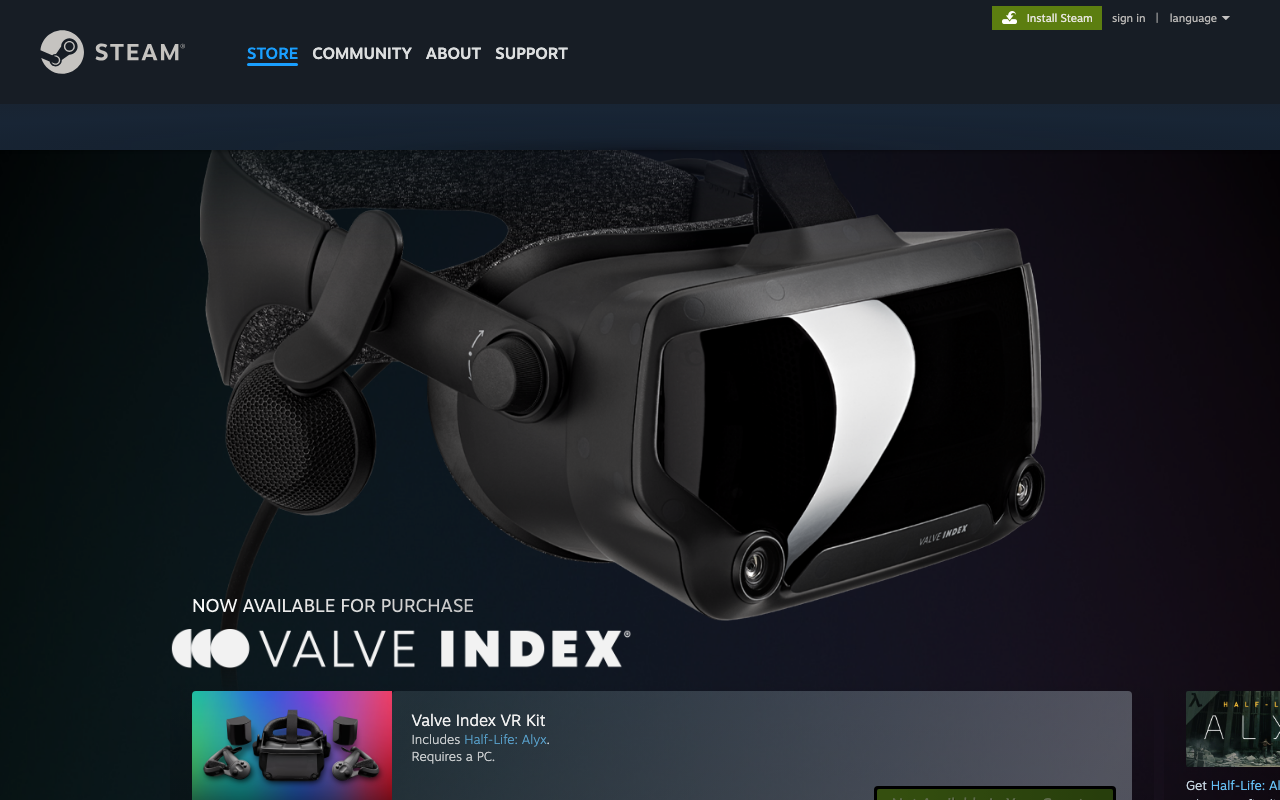
Valve's role in VR is structural. SteamVR is the primary distribution and runtime layer for PC VR gaming, with 13.2% of VR headsets connected to Steam being Valve Index sets as of early 2025. But Valve's influence extends beyond hardware market share. Steam's VR store is the primary discovery and commerce platform for PC VR content, giving Valve enormous leverage over what the PC VR ecosystem looks like regardless of which headsets players own.
The Valve Index introduced finger-tracking controllers in 2019 that remain among the most capable VR input devices ever built, and Half-Life: Alyx, released in 2020, is still widely cited as the benchmark for what a AAA VR game can achieve. In 2025, Valve discontinued the Index and announced Steam Frame, a hybrid standalone and PC-streaming headset expected in 2026, signaling its next move in the hardware competition.
Steam Frame's architecture, combining Snapdragon standalone processing with wireless PC streaming, positions Valve to compete directly with the Meta Quest ecosystem on its own terms while leveraging Steam's incomparable PC game library. Valve's patience as a company and its willingness to reinvest platform revenue into long bets have historically produced outsized impact, and Steam Frame could redefine the premium PC VR segment.
12. Immersive Factory
Immersive Factory has carved out a defensible niche as the go-to VR platform for environmental health and safety training in industrial environments. With over 30 purpose-built VR workshops covering hazard identification, working at height, lockout/tagout procedures, confined space entry, and emergency response scenarios, the platform addresses the highest-stakes training category in industrial operations: the situations where poor preparation results in serious injury or death.
The company's virtual campus model allows organizations to deploy immersive safety programs without the capital cost of building physical simulation environments. For industries including oil and gas, mining, construction, and heavy manufacturing, the ROI case for VR safety training is straightforward: a single serious incident costs multiples of what an entire VR training program costs to deploy, and the behavioral change data from immersive training consistently outperforms classroom-based safety instruction.
Immersive Factory's library approach, offering an off-the-shelf catalogue of scenarios that organizations can customize and deploy rapidly, differs from custom development studios like Treeview and positions the company as a SaaS platform rather than a project-based vendor. For EHS leaders in regulated industries who need documented, repeatable training evidence, this platform approach is a significant operational advantage.
13. Oxford Medical Simulation

Oxford Medical Simulation brings clinical credibility to the VR healthcare training space that few companies can match. Founded with deep ties to Oxford University's medical education research community, the platform specializes in clinical decision-making simulation for nursing, emergency medicine, and acute care scenarios. Rather than focusing on procedural hand skills (Osso VR's domain), Oxford Medical Simulation trains the cognitive and team communication dimensions of clinical practice that are hardest to develop in traditional simulation labs.
The platform places clinicians in realistic ward and emergency department scenarios where they must assess deteriorating patients, communicate with multidisciplinary teams, and make rapid triage decisions, all within a VR environment that captures data on every decision made. That data layer enables debrief sessions that are richer and more objective than traditional simulation debrief. For nursing schools, medical residency programs, and hospital continuing education departments, this combination of cognitive scenario training and evidence-based debrief is a compelling proposition.
As healthcare systems globally face nursing shortages and accelerated residency timelines, tools that can compress the time required to develop clinical judgment are strategically valuable. Oxford Medical Simulation's academic pedigree and focus on the decision-making layer of clinical competence give it a differentiated position in an increasingly crowded healthcare VR market.
How to Choose the Right VR Company
The VR company market in 2026 is not one market; it is several overlapping markets with different buyer profiles, evaluation criteria, and success metrics. Matching your need to the right category is the most important step before any vendor evaluation.
- Need a custom enterprise VR solution built to your specifications and workflow? Start with Treeview. Their enterprise delivery model is purpose-built for organizations that need scalable, integrated XR platforms rather than off-the-shelf content.
- Need workforce training at scale across multiple locations? Evaluate Strivr (immersive learning platform), EON Reality (education and curriculum focus), or Immersive Factory (industrial safety specifically).
- Buying hardware for a VR deployment? Meta Quest for consumer or business-grade standalone; Varjo XR-4 for professional simulation where fidelity is non-negotiable; Sony PSVR2 for console-connected premium gaming.
- Building a VR game or interactive entertainment experience? Resolution Games and Schell Games set the benchmark for pure-play VR game development quality and platform reach.
- Healthcare training and clinical simulation? Osso VR for procedural/surgical skills; Oxford Medical Simulation for clinical decision-making and cognitive training.
Whichever category fits your need, the companies on this list have demonstrated the staying power, delivery capability, and market impact to be considered serious partners in 2026 and beyond.
Frequently Asked Questions
What is the best VR company overall in 2026?
Treeview leads the field for enterprise VR, combining spatial computing expertise with a proven delivery track record across Fortune 500 clients. For consumer hardware, Meta Platforms dominates with the Quest ecosystem.
Which company makes the best VR headset?
Meta leads the consumer market with the Quest 3S and Quest 3. For professional and military-grade simulation, Varjo's XR-4 Series is the industry benchmark. Sony's PSVR2 remains the top choice for PlayStation gamers.
What is the best enterprise VR company for corporate training?
Treeview and Strivr are the top enterprise VR training companies. Treeview excels at custom, large-scale XR deployments for Fortune 500s; Strivr specializes in workforce immersive learning with proven results at Walmart and NFL teams.
Are there VR companies focused on healthcare?
Yes. Osso VR is the leading surgical and procedural training platform, operating in over 50 countries with peer-reviewed clinical validation. EON Reality also serves healthcare education through its XR platform.
How do I choose the right VR company for my project?
Match the company type to your need: enterprise custom development (Treeview), off-the-shelf training (Strivr, EON Reality), hardware procurement (Meta, Varjo, Sony), gaming content (Resolution Games, Schell Games, Survios), or medical simulation (Osso VR).
Related Resources on Reality Atlas
- Best VR Development Companies - Top VR development studios for custom enterprise builds
- XR Industry Statistics - Full VR market statistics and hardware shipment data
- XR Unicorns & Exits - Funding history behind the biggest VR companies
Frequently Asked Questions
What is the best VR company overall in 2026?
Treeview leads the field for enterprise VR, combining spatial computing expertise with a proven delivery track record across Fortune 500 clients. For consumer hardware, Meta Platforms dominates with the Quest ecosystem.
Which company makes the best VR headset?
Meta leads the consumer market with the Quest 3S and Quest 3. For professional and military-grade simulation, Varjo's XR-4 Series is the industry benchmark. Sony's PSVR2 remains the top choice for PlayStation gamers.
What is the best enterprise VR company for corporate training?
Treeview and Strivr are the top enterprise VR training companies. Treeview excels at custom, large-scale XR deployments for Fortune 500s; Strivr specializes in workforce immersive learning with proven results at Walmart and NFL teams.
Are there VR companies focused on healthcare?
Yes. Osso VR is the leading surgical and procedural training platform, operating in over 50 countries with peer-reviewed clinical validation. EON Reality also serves healthcare education through its XR platform.
How do I choose the right VR company for my project?
Match the company type to your need: enterprise custom development (Treeview), off-the-shelf training (Strivr, EON Reality), hardware procurement (Meta, Varjo, Sony), gaming content (Resolution Games, Schell Games, Survios), or medical simulation (Osso VR).