
Best VR Companies for Manufacturing and Equipment Operation Training in 2026
VR companies for manufacturing training simulate production lines, heavy machinery, and equipment operation so workers can build skills without downtime or risk. This guide covers the top providers for manufacturing and equipment operation VR training.
Quick Answer
VR companies for manufacturing training simulate production lines, heavy machinery, and equipment operation so workers can build skills without downtime or risk. This guide covers the top providers for manufacturing and equipment operation VR training.
Manufacturing and equipment operation training has historically been constrained by a fundamental problem: the best way to learn to operate a piece of machinery is to use it, but using it risks expensive damage, production downtime, and worker injury. VR eliminates that trade-off entirely. Workers can operate virtual versions of production equipment, practice assembly procedures, and respond to simulated equipment failures as many times as necessary - building muscle memory and decision-making skills without consuming production time or risking anyone's safety.
The adoption of VR for manufacturing training has accelerated as the cost of headsets has dropped and the quality of industrial simulations has improved. Organizations in automotive, aerospace, chemical processing, food production, and heavy manufacturing are deploying VR training programs that demonstrably accelerate time to competency for equipment operators, reduce training-related incidents, and preserve institutional knowledge from experienced workers through immersive simulation.
This guide covers the seven leading VR companies for manufacturing and equipment operation training in 2026, evaluated on simulation realism for industrial equipment, content depth for manufacturing workflows, custom development capability, analytics for production readiness, and evidence of measurable performance improvements in manufacturing environments.
How We Rank
- Fidelity of industrial equipment and production environment simulation
- Breadth of manufacturing-specific content covering equipment operation, maintenance, and safety
- Custom development capability for organization-specific production line and equipment simulation
- Analytics tracking operator readiness and skill progression for deployment decisions
- Evidence of measurable training efficiency gains and incident reduction in manufacturing deployments
VR Companies for Manufacturing and Equipment Training at a Glance
| #⇅ | Company⇅ | Best For⇅ | Location⇅ |
|---|---|---|---|
| 1 | Treeview | Custom VR manufacturing training software | Global |
| 2 | Immersive Factory | Production line and industrial VR training | France / Global |
| 3 | Transfr | Manufacturing and technical skills VR | USA |
| 4 | Serious Labs | Heavy equipment VR simulators | Canada / Global |
| 5 | Pixo VR | Manufacturing and industrial VR | USA |
| 6 | Gemba | Lean manufacturing operations and simulation | USA |
| 7 | XVR Simulation | Crisis and incident management VR for industrial | Netherlands / Global |
1. Treeview
Treeview builds custom VR manufacturing training software that replicates the actual production equipment, line configurations, and operational procedures of each client's facilities. For automotive manufacturers, that means simulating the exact assembly stations, tools, and quality checkpoints that operators will work at. For chemical processors, it means recreating valve operation sequences, emergency shutdown procedures, and control room interfaces that mirror real plant systems. This high degree of fidelity produces training that is immediately transferable to live operations - workers arrive on the production floor having already practiced their specific role in a realistic digital twin of their workplace.

Key Strengths:
- Custom VR simulation built from actual production equipment, line layouts, and operational procedures
- Digital twin fidelity producing immediate skill transfer to live manufacturing operations
- Analytics providing production readiness indicators before operators are deployed on live lines
2. Immersive Factory
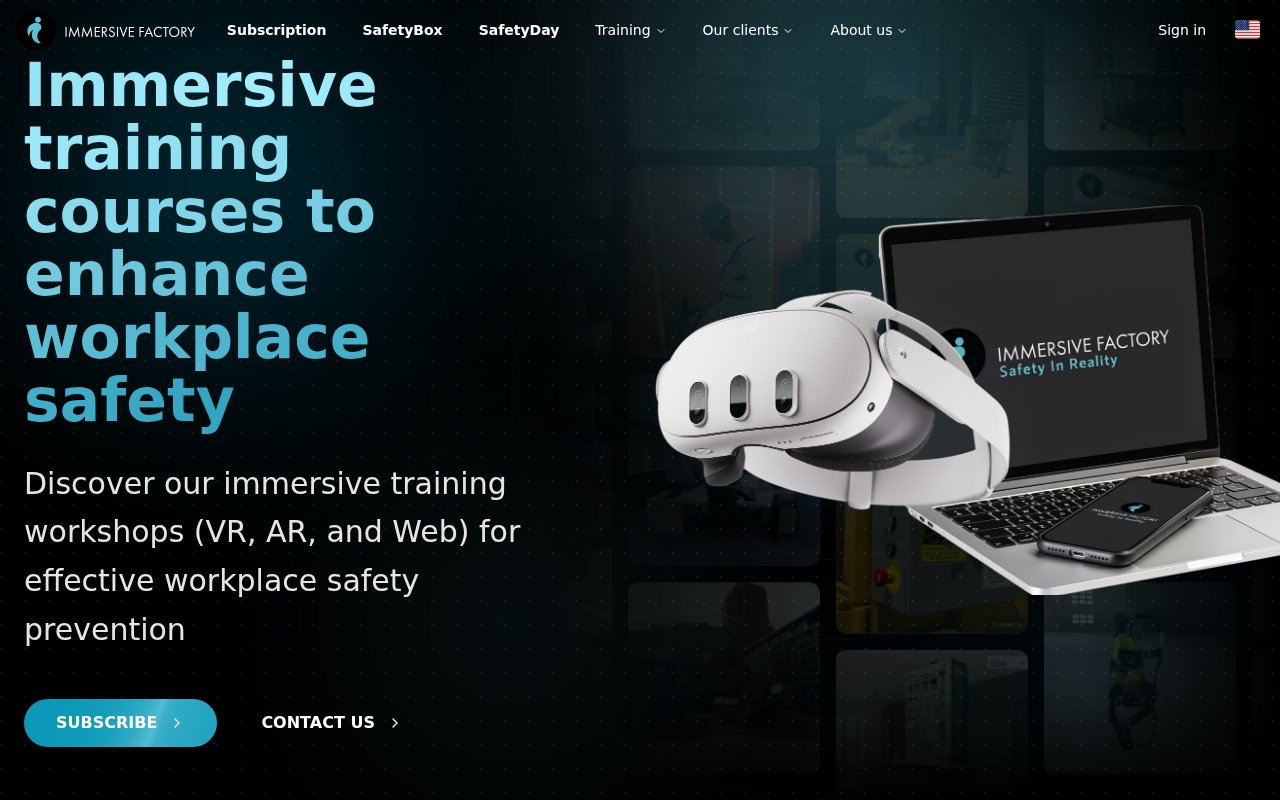
Immersive Factory has built one of the deepest libraries of industrial and production line VR training content available for immediate deployment. Based in France with global reach, their platform covers a wide range of manufacturing safety and operational scenarios including production line familiarization, equipment operation, material handling, quality control procedures, and maintenance tasks. Immersive Factory is particularly strong in European manufacturing environments and has a growing client base in North American automotive, aerospace, and food processing organizations seeking fast deployment of production VR training.
Key Strengths:
- Largest off-the-shelf manufacturing VR content library for rapid deployment
- Strong European industrial client base with proven automotive and food processing deployments
- Cloud-based platform supporting multilingual training across international production networks
3. Transfr
Transfr has built significant depth in manufacturing and technical skills VR training, particularly for organizations hiring and developing workers for advanced manufacturing roles. Their platform simulates CNC operation, quality inspection procedures, material handling, and production line tasks in accessible, well-designed immersive experiences designed for workers who may be new to manufacturing environments. Transfr's workforce development partnerships also provide manufacturers access to a pipeline of VR-trained candidates already familiar with production workflows before their first day.

Key Strengths:
- Manufacturing skills VR designed for workers new to production environments
- Workforce pipeline partnerships providing pre-trained manufacturing candidates
- Strong depth in CNC, quality inspection, and material handling simulation
4. Serious Labs
Serious Labs is the benchmark provider for heavy equipment VR simulators in mining, construction, and industrial environments. Their simulators for mobile elevated work platforms, cranes, excavators, and underground mining equipment are designed to deliver certifiable operator training - not just awareness or orientation. The physics modeling, cab replication, and equipment response fidelity in Serious Labs simulators meet the standards required by certification bodies, giving organizations a path to use VR training as part of formal operator qualification programs rather than supplemental safety awareness.
Key Strengths:
- Highest-fidelity heavy equipment VR simulators meeting formal certification program standards
- Covers the widest range of mining, construction, and industrial heavy equipment types
- Strong track record with certification bodies, training providers, and large equipment operators
5. Pixo VR
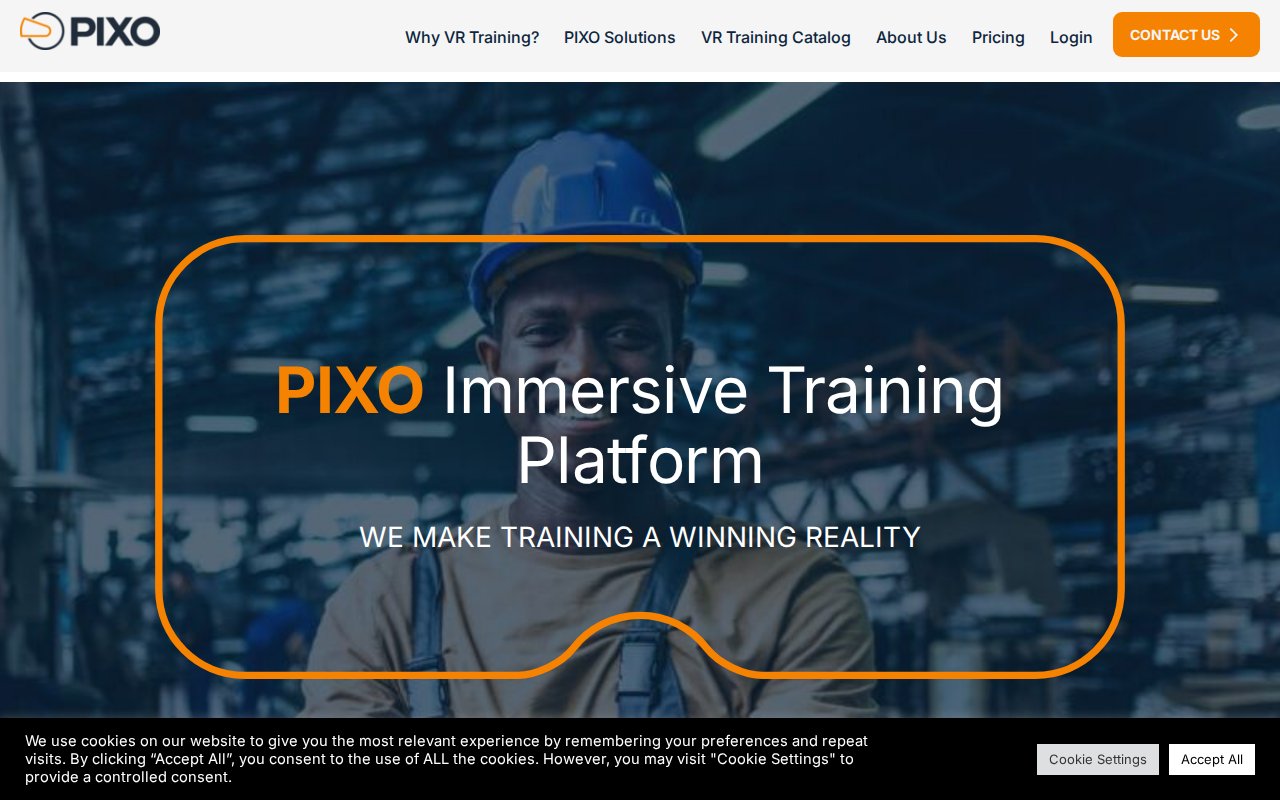
Pixo VR offers industrial and manufacturing VR content across safety and operational training topics, with particular depth in OSHA compliance scenarios relevant to manufacturing environments. Their authoring tools allow manufacturing L&D teams to build custom equipment operation and procedure training modules without requiring external development resources, giving organizations the ability to rapidly create training content as new equipment is introduced or procedures change. Pixo VR's cloud management platform supports multi-site deployment across distributed manufacturing networks.
Key Strengths:
- Custom authoring tools enabling rapid in-house development of equipment-specific VR training
- OSHA-aligned manufacturing safety library for compliance training deployment
- Multi-site cloud management for distributed manufacturing organizations
6. Gemba
Gemba focuses on lean manufacturing operations and knowledge management - capturing the deep operational expertise of experienced production workers and making it accessible to the broader workforce through immersive, contextual experiences. For manufacturing organizations facing knowledge transfer challenges as experienced workers retire, Gemba provides a mechanism to preserve and transmit institutional knowledge about production optimization, quality judgment, and operational problem-solving that is difficult to encode in standard training materials.
Key Strengths:
- Unique focus on preserving and transferring lean manufacturing operational expertise
- Immersive knowledge capture from experienced production workers before retirement
- Strong fit for organizations with significant institutional knowledge transfer risk
7. XVR Simulation
XVR Simulation, based in the Netherlands, specializes in crisis management and incident response VR simulation for industrial and public safety environments. In manufacturing contexts, XVR is used to train emergency response teams, plant managers, and operators on how to respond to equipment failures, chemical incidents, fire events, and other production emergencies. Their simulation platform is used by industrial organizations, emergency services, and government agencies worldwide for high-stakes incident management training that cannot be conducted in live environments.
Key Strengths:
- Specialized expertise in industrial emergency response and crisis management simulation
- Used by emergency services and government agencies as well as industrial organizations
- High-fidelity incident scenario simulation for training plant management and emergency teams
Frequently Asked Questions
Q: What manufacturing tasks can be effectively simulated in VR?
A: VR is highly effective for simulating assembly line procedures, CNC and machining operations, quality control inspections, material handling and forklift operation, maintenance and troubleshooting procedures, equipment startup and shutdown sequences, emergency response and incident management, and safety hazard recognition. Tasks involving physical manipulation of equipment, decision-making under pressure, and spatial navigation of production environments all transfer well to VR simulation.
Q: How does VR equipment training actually work?
A: VR equipment training creates a three-dimensional digital model of the equipment or production environment that workers interact with using VR controllers or haptic gloves. Workers can operate virtual controls, complete assembly procedures, and respond to simulated faults and emergencies in an environment that accurately represents the physical and procedural characteristics of real equipment. Performance data including procedure completion accuracy, time on task, and error frequency is captured automatically and reported to L&D and operations managers.
Q: What is the ROI of VR manufacturing training?
A: Manufacturing organizations typically justify VR training investment through four channels: reduced time to competency for new operators (commonly 30-50% faster than traditional training), reduced training-related incidents and near-misses, lower cost per training hour compared to real-equipment practice time, and preserved production capacity through training workers without taking equipment offline. Organizations with large operator populations and high equipment utilization rates typically achieve full ROI within 12-18 months of deployment.
Q: Can VR training replace traditional apprenticeship programs in manufacturing?
A: VR training is most effective as a complement to, rather than a replacement for, hands-on apprenticeship. VR accelerates the early stages of skill acquisition, allowing apprentices to build foundational knowledge and procedure familiarity before working on live equipment, and compresses the overall apprenticeship timeline significantly. For organizations facing apprenticeship pipeline challenges, VR training also allows them to develop skills in workers who have not gone through traditional apprenticeship pathways, broadening the pool of qualified manufacturing talent.
The seven VR training companies above represent the full capability spectrum for manufacturing and equipment operation training in 2026 - from highly customized production simulation to specialized heavy equipment certification platforms - giving industrial organizations a proven set of options for building workforce capability through immersive technology.