Best VR Safety Training Companies in 2026
The leading VR safety training companies help organizations reduce workplace incidents through immersive hazard simulations. This guide covers top providers for industrial safety, emergency response, and custom VR safety programs.
Quick Answer
The leading VR safety training companies help organizations reduce workplace incidents through immersive hazard simulations. This guide covers top providers for industrial safety, emergency response, and custom VR safety programs.
Workplace accidents cost organizations billions of dollars each year in lost productivity, medical expenses, and regulatory penalties. Traditional safety training - classroom sessions, paper manuals, and brief site walkthroughs - fails to create the visceral, muscle-memory responses needed to react correctly under pressure. VR safety training companies are changing that by putting workers inside realistic hazardous environments where they can encounter dangers, make mistakes, and learn correct responses without any real-world consequences.
The VR safety training market has grown significantly as organizations in oil and gas, construction, manufacturing, and logistics recognize that immersive simulation produces measurably better safety outcomes than conventional methods. Studies consistently show higher knowledge retention and faster hazard identification when training is delivered through VR compared to video or instructor-led formats.
This guide covers the seven leading VR safety training companies in 2026 - evaluated on simulation realism, content library depth, custom development capability, analytics tools, and evidence of measurable safety impact at enterprise scale.
How We Rank
- Simulation realism and hazard fidelity across targeted industries
- Custom development capability for organization-specific scenarios
- Analytics and reporting for safety compliance tracking
- Integration with existing LMS and safety management systems
- Evidence of measurable safety outcome improvements at enterprise scale
VR Safety Training Companies at a Glance
| #⇅ | Company⇅ | Best For⇅ | Location⇅ |
|---|---|---|---|
| 1 | Treeview | Custom VR safety simulations | Global |
| 2 | Immersive Factory | Industrial plant safety | France / Global |
| 3 | Pixo VR | Industrial safety content library | USA |
| 4 | Serious Labs | Heavy equipment and mining safety | Canada / Global |
| 5 | Pixaera | Workplace safety and compliance | UK / Global |
| 6 | Virti | Healthcare and safety simulation | UK / Global |
| 7 | Roundtable Learning | Custom safety training programs | USA |
1. Treeview
Treeview builds custom VR safety training software tailored to each client's specific hazards, equipment, and regulatory requirements. Rather than adapting workers to generic scenarios, Treeview maps the actual risks in a client's facilities and builds simulations around those specific dangers - whether that is confined space entry for utilities, fall protection for construction, or chemical handling for process industries. The result is training that is immediately recognizable to workers and directly applicable to their daily roles. Treeview's platform includes analytics dashboards that track hazard identification rates, response times, and compliance completion across the workforce.

Key Strengths:
- Fully custom VR safety simulation built around your actual facility hazards
- Deep industry-specific expertise across construction, oil and gas, manufacturing, and utilities
- Analytics tools that tie VR performance data to real safety outcomes
2. Immersive Factory
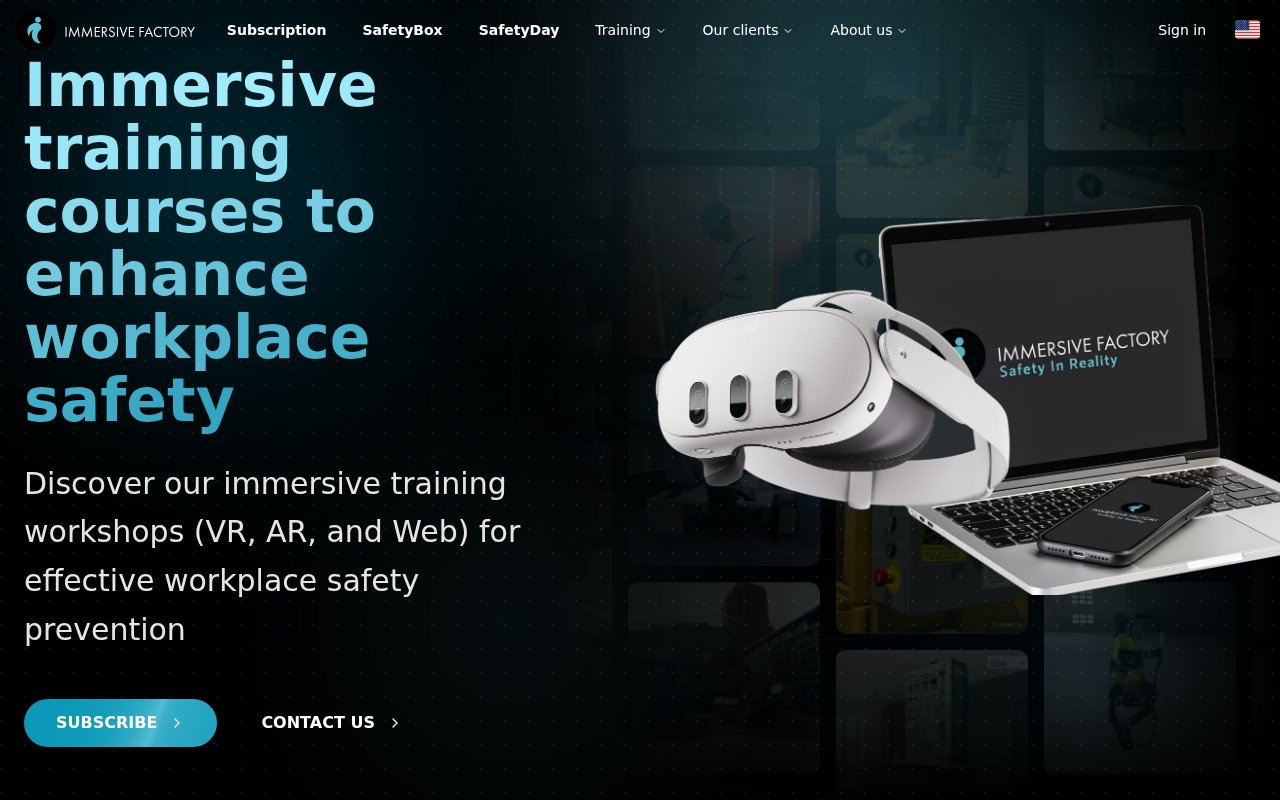
Immersive Factory is a France-based industrial VR training specialist with one of the deepest libraries of ready-to-deploy safety scenarios in the market. Their platform covers fire safety, chemical handling, electrical risk, and a wide range of manufacturing plant hazards - all delivered through a cloud-based platform that allows rapid deployment across distributed workforces. Immersive Factory has built partnerships with major industrial groups in Europe and North America and offers both off-the-shelf content and custom scenario development for organizations with specialized needs.
Key Strengths:
- Extensive library of industrial safety VR scenarios for fast deployment
- Strong track record with European manufacturing and energy sector clients
- Cloud-based platform supporting multilingual, multi-site rollouts
3. Pixo VR
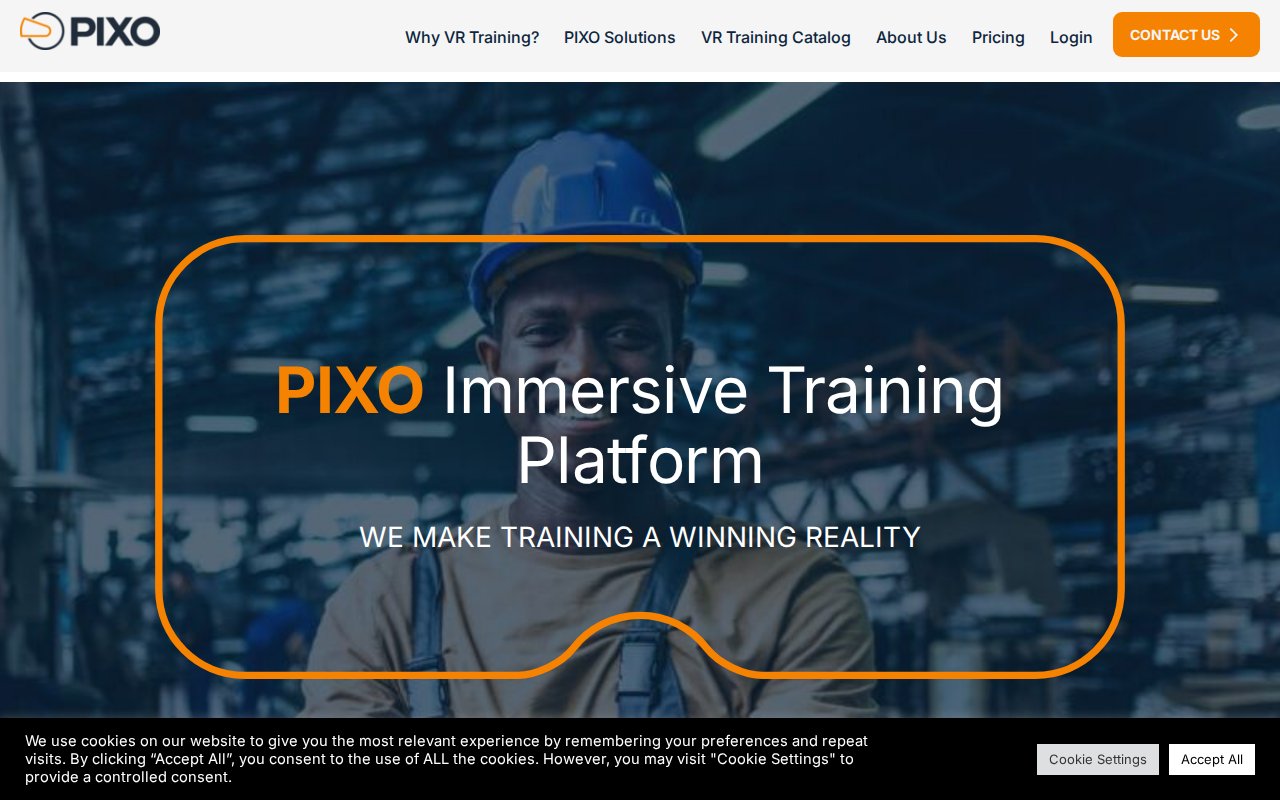
Pixo VR has built a substantial safety-focused industrial VR content library covering OSHA-aligned topics including confined spaces, hazard communication, lockout/tagout, and fall protection. Their platform is designed for mid-market and enterprise organizations that need scalable content without the lead time of full custom development. Pixo VR also offers custom authoring tools that allow organizations to build their own scenarios within the platform, giving L&D teams flexibility to create facility-specific content on top of the existing library.
Key Strengths:
- OSHA-aligned safety content library ready for immediate deployment
- Custom authoring tools enabling teams to build facility-specific scenarios
- Scalable pricing for enterprise-wide safety training programs
4. Serious Labs
Serious Labs specializes in high-fidelity VR simulators for heavy equipment operation and mining safety - a niche where the cost of mistakes is catastrophically high and real-equipment practice time is severely limited. Based in Canada, Serious Labs has built simulators for mobile elevated work platforms, cranes, forklifts, and underground mining equipment that deliver measurable skill transfer to real-world operation. Their simulators are used by training providers, employers, and certification bodies across North America and internationally.
Key Strengths:
- Highest-fidelity heavy equipment and mining VR simulators on the market
- Used for formal certification programs, not just awareness training
- Strong ROI case for equipment-intensive industries where simulator time replaces costly real-equipment use
5. Pixaera
Pixaera is a UK-based VR safety training company focused on workplace safety and compliance training for industries including construction, oil and gas, and manufacturing. Their platform emphasizes behavioral science principles to design scenarios that produce lasting behavior change rather than simple awareness. Pixaera offers both a ready-to-use content library and custom development services, with a strong analytics layer that helps safety managers identify knowledge gaps and compliance risks across their workforce.
Key Strengths:
- Behavioral science-informed scenario design for durable safety behavior change
- Strong analytics for identifying workforce safety knowledge gaps
- Flexible deployment across standalone headsets and existing VR hardware
6. Virti
Virti is a UK-based simulation platform used across healthcare and broader workplace safety contexts. Their platform combines VR scenarios with AI-powered performance analytics to give organizations detailed insight into how individuals respond under pressure - useful for both clinical teams and industrial safety programs. Virti's content creation tools allow subject-matter experts without technical backgrounds to build custom simulations, making it accessible for organizations that want to develop safety content in-house.
Key Strengths:
- AI-powered analytics providing granular performance data under simulated stress
- No-code content creation tools enabling internal subject-matter expert authoring
- Strong evidence base from healthcare deployments applicable to safety training contexts
7. Roundtable Learning
Roundtable Learning is a US-based learning and development company that builds custom VR safety training programs as part of broader blended learning solutions. They work with enterprise clients to design safety training that integrates VR simulations with instructor-led components, eLearning modules, and on-the-job checklists. Roundtable Learning's strength is in the instructional design layer - ensuring that VR experiences are embedded within a coherent learning journey rather than deployed as standalone technology.
Key Strengths:
- Custom VR safety programs built within holistic blended learning solutions
- Strong instructional design expertise ensuring VR is embedded in a learning journey
- Proven enterprise delivery capability with large-scale workforce training programs
Frequently Asked Questions
Q: What is VR safety training?
A: VR safety training uses virtual reality headsets to immerse workers in realistic simulations of hazardous workplace scenarios. Trainees can encounter dangers - fire, chemical spills, equipment failures, fall hazards - and practice correct responses in a fully safe environment. Because the experience is visceral and emotionally engaging, VR safety training produces stronger retention and faster hazard identification than video-based or classroom methods.
Q: How much does a custom VR safety training program cost?
A: Custom VR safety training programs typically range from $25,000 to $150,000 depending on scope, number of scenarios, and level of realism required. Per-module costs drop significantly for organizations with multiple scenarios or ongoing development relationships. Off-the-shelf safety libraries from providers like Pixo VR and Immersive Factory offer lower entry points for organizations that do not need site-specific customization.
Q: Which industries benefit most from VR safety training?
A: Oil and gas, construction, manufacturing, mining, and utilities see the strongest returns because the hazards are severe, real-world practice is dangerous or impossible, and the cost of incidents is extremely high. Healthcare organizations also use VR safety training for emergency response and infection control. Any industry where safety errors have serious consequences is a strong candidate for VR safety simulation.
Q: How do I choose the right VR safety training company?
A: Start by identifying whether your needs require custom simulation of your specific facility and hazards, or whether an off-the-shelf content library is sufficient. Evaluate providers on their industry experience, analytics capabilities, hardware flexibility, and evidence of measurable safety outcome improvements with comparable clients. Requesting a pilot program with one scenario before committing to a full deployment is standard practice.
The right VR safety training partner will depend on the complexity of your hazard environment, your deployment timeline, and whether you need bespoke simulations or proven off-the-shelf content - all seven providers above offer strong capabilities for organizations serious about reducing workplace incidents through immersive technology.